-
E-mail
15589666969@163.com
-
Phone
15589666969
-
Address
Chang'an Industrial Park
Product Categories
- Rural renovation of sewage treatment equipment
- Process of aquaculture wastewater treatment equipment
- Small scale sewage treatment equipment
- Integrated sewage treatment equipment
- Sewage treatment equipment
- New rural sewage project renovation
- Township sewage treatment equipment
- Integrated sewage treatment system
Shandong Miyang Environmental Engineering Co., Ltd


Newly built integrated sewage treatment equipment for nursing homes
NegotiableUpdate on 01/21
- Model
- Nature of the Manufacturer
- Producers
- Product Category
- Place of Origin
Overview
If the surface of the floating slag in the separation area is uneven and there are often large bubbles bursting on the pool surface of the newly built integrated sewage treatment equipment for nursing homes, it indicates that the adhesion between bubbles and flocs is poor. The coagulation system should be checked and adjusted or appropriate measures should be adopted; Unqualified effluent is returned to the collection tank, while qualified effluent enters the subsequent treatment system.
Product Details
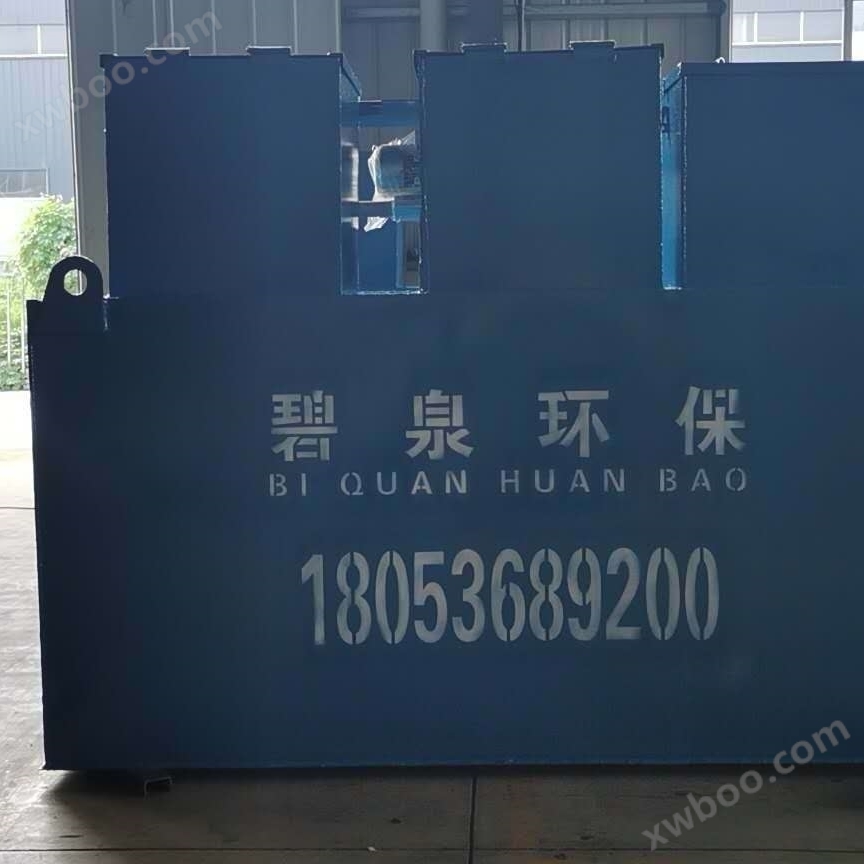
Newly built integrated sewage treatment equipment for nursing homes
Newly built integrated sewage treatment equipment for nursing homes——Instructions for use
1. Keep a record of the normal operation of domestic sewage treatment equipment, including the amount of treated water, dosage of chemicals, amount of dissolved gas, pressure of dissolved gas tank, water temperature, power consumption, inlet and outlet water quality, slag discharge cycle, sludge moisture content, etc.
2. Regularly observe the condition of the air flotation tank surface. If it is found that the floating surface in the contact area is uneven, large bubbles appear locally, or the water flow is unstable, the release device should be removed to remove the blockage; If the surface of the floating slag in the separation zone is uneven and there are often large bubbles bursting on the pool surface, it indicates that the adhesion between the bubbles and flocs is poor. The coagulation system should be checked and adjusted or appropriate measures should be adopted; Unqualified effluent is returned to the collection tank, while qualified effluent enters the subsequent treatment system.
Regularly check the packing and lubrication system of the air compressor and water pump in the domestic sewage treatment equipment, and frequently add oil.
What are the advantages of using integrated domestic sewage treatment equipment?
1. The integrated sewage treatment equipment can be buried underground and does not occupy surface area;
2. The noise and odor generated during the operation of the equipment are low, and the impact on the surrounding environment is minimal;
3. High degree of purification, with less sludge generated by the entire system;
4. High degree of automation, convenient management, no need for dedicated personnel to manage;
5. Stable technology and easy maintenance;
6. Low energy consumption, saving operating costs.
What is the working principle of integrated sewage treatment equipment?
The integrated sewage treatment equipment mainly relies on AO biological processes. In the filtration tank, the organic concentration of sewage is relatively high. At this point, in a hypoxic environment, the organic nitrogen in the wastewater will be converted into NH3-N. Using organic carbon as an electron donor, a combination of NH3-N and organic nitrogen channels is used to form new cellular materials. Therefore, the filter not only has high organic matter removal efficiency, but also can reduce the workload of subsequent aerobic tanks.
Sewage treatment equipment
What are the commonly used sewage treatment equipment
The classification of sewage treatment equipment includes:
1. Centrifuge
Centrifuges are mainly used to separate solid particles from liquids in suspensions; Or separate two immiscible liquids with different densities in the emulsion (such as separating cream from milk); It can also be used to remove liquids from wet solids, such as using a washing machine to spin dry and wet clothes; The special high-speed tube separator can also separate gas mixtures of different densities; By taking advantage of the different settling velocities of solid particles with different densities or particle sizes in liquids, some settling centrifuges can also classify solid particles according to density or particle size.
2. Sludge dewatering machine
The characteristics of sludge dewatering machine are automatic control operation, continuous production, stepless speed regulation, suitable for various types of sludge, and applicable for sludge dewatering in various industries such as water supply and drainage, papermaking, casting, leather, textile, chemical, food, etc.
3. Aeration machine
The aerator injects "microbubbles" directly into untreated sewage through a diffuser impeller. Under the combined action of coagulants and flocculants, suspended solids undergo physical and chemical flocculation, forming large suspended solids flocs. Under the buoyancy of the bubble group, the "flocs" float to the liquid surface to form floating slag, which is separated from the water by a scraper; No need to clean the nozzle, there will be no blockage. This device has good overall integrity, easy installation, and saves operating costs and floor space.
4. Microfiltration machine
A microfilter is a rotary drum screen filtration device. The treated wastewater enters the drum along the axial direction and flows out through the screen in a radial radiation pattern. Impurities in the water (fine suspended solids, fibers, pulp, etc.) are trapped on the inner surface of the screen on the drum. When the impurities trapped on the filter screen are carried to the upper part by the drum, they are flushed back into the slag discharge tank by the pressure flushing water and flow out. During operation, the diameter of 2/5 of the drum is exposed to the water surface, with a rotation speed of 1-4r/min. The filtration speed of the filter can be 30-120m/h, the flushing water pressure is 0.5-1%, and the flushing water volume is 0.5-1.0% of the production water volume. When used for reservoir water treatment, the algae removal efficiency can reach 40-70%
Similar Product Recommend