-
E-mail
shineso@shineso.com
- Phone
-
Address
Room 405, Building B, No. 11 Xiyuan Eighth Road, Xihu Science and Technology Park, Hangzhou City
Product Categories
Hangzhou Xunshu Technology Co., Ltd

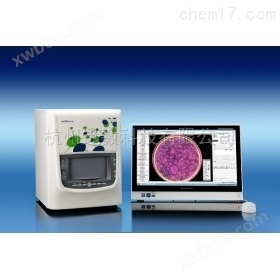
MF4 Microscopic Analysis, Colony Counting Screening, Antibacterial Zone Combination Instrument
NegotiableUpdate on 02/18
- Model
- Nature of the Manufacturer
- Producers
- Product Category
- Place of Origin
Overview
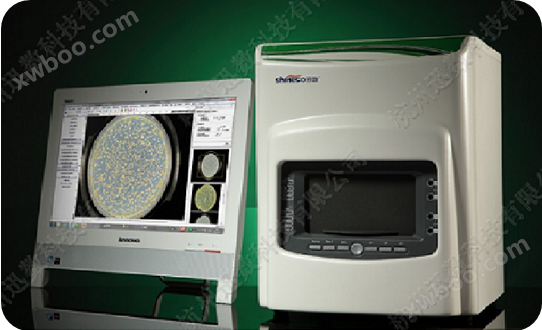
The MF4 multifunctional all-in-one machine consists of a microscopic imaging analysis system and a colony/inhibition zone imaging analysis system, which realize digital analysis of routine microbial experiments: microscopic cell observation and analysis, automatic colony counting and screening, inhibition zone measurement and potency analysis.
Product Details
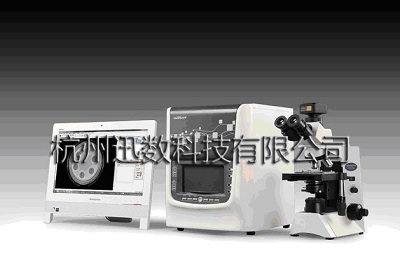
The MF4 multifunctional all-in-one machine consists of a microscopic imaging analysis system and a colony/inhibition zone imaging analysis system, which realize digital analysis of routine microbial experiments: microscopic cell observation and analysis, automatic colony counting and screening, inhibition zone measurement and potency analysis.
Designed according to the requirements of the food and drug testing computer information system, with anti tampering technology, intelligent reconstruction technology of testing environment testing process, and watermark signature technology as the core, a multi-level and mutually restrictive security management guarantee system is constructed to ensure the security of the system, the integrity and authenticity of data, and meet the requirements of audit tracking.
Microscopic image analysis
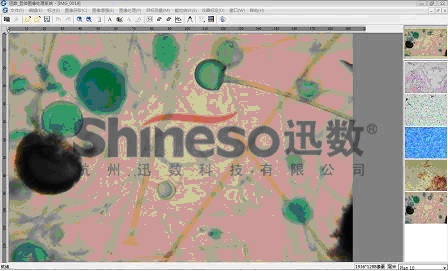
Microscopic digital image observation and preservation
Equipped with an Olympus CX31 microscope and a 20 megapixel 1-inch CMOS image sensor. The ultra large chip enables screen observation to be equivalent to the visual field observed by the naked eye through an eyepiece, with delicate images and clear cell clarity.
Cell and spore counting
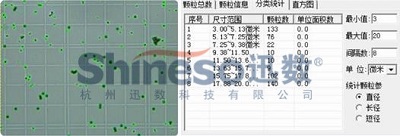
Equipped with a large number of statistical functions, it can quickly count spores and cells, such as regional statistics, diameter classification statistics, color recognition statistics, adhesion segmentation, impurity removal, mouse click statistics, etc.
Microscopic measurement and image processing
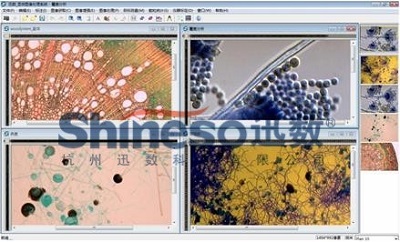
It can accurately measure the diameter, angle, curvature, circumference, area of cells and hyphae, as well as the length of any manually drawn straight lines, arcs, curves, etc. Built in 27 image processing methods, such as adaptive enhancement, image smoothing, edge sharpening, filtering, edge detection, morphological operations, etc., as well as text and graphic embedding tools, provide assistance for writing scientific research papers.
Colony counting and screening
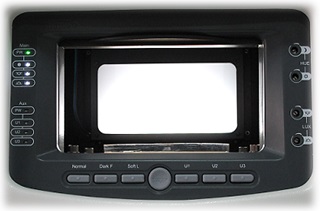
Fully enclosed darkroom shooting
Adopting fully enclosed, wide light strip lighting technology and ergonomic porthole door design, it isolates the interference of ambient light, eliminates the light spot and halo phenomenon formed by the refraction of stray light in glass culture dishes, and provides accurate light and shadow conditions for live bacterial counting. The upper light source provides 360 degree flexible mixed light illumination, which can highlight the color and texture of the colony, making the wrinkles, depressions, and jagged edges of the colony surface more three-dimensional; The bottom light source is a crystal sharp suspended dark field illumination, which not only clearly outlines the outline of bacterial colonies, but also distinguishes the basal hyphae and aerial hyphae of fungi or actinomycetes.
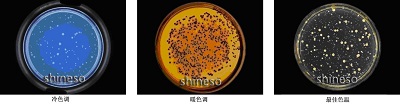
Tri color LED hybrid light source, color temperature adjustment
Long life, low power consumption, environmentally friendly three color LED mixed light, with a color temperature range of 3500K-8500k controlled by the ratio of warm and cool light, captures the most realistic color of bacterial colonies.
Rich image algorithms
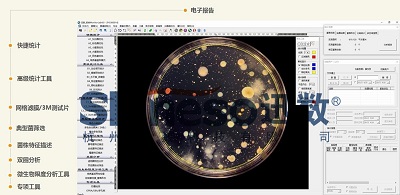
Xunshu is a common colony counting problem for petri dishes, such as bacteria, mold, actinomycetes, mold and yeast, coliform bacteria, *, grid filter membranes, 3M test strips, spiral petri dishes, etc. It provides convenient and fast one click intelligent statistics and advanced statistical tools.
Architecture design to ensure system security and data security
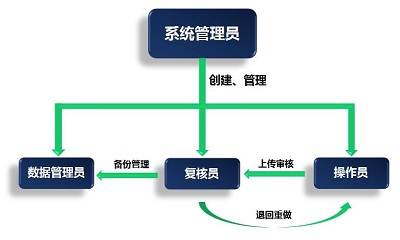
The four tiered system architecture of "system administrator, data administrator, operator, and reviewer" is divided into functions and permissions to ensure the security, integrity, and authenticity of data information.
System administrator: responsible for creating and managing accounts and login passwords for all operators and auditors.
Data administrator: responsible for archive management, sealing, and computer database management of all test data.
Operator: Responsible for testing, self checking, correcting, generating electronic reports, submitting for review, and printing reports on approved documents for culturing dish colonies
Auditor: Responsible for reviewing the test reports submitted by operators.
Watermark signature, tamper proof, intelligent reconstruction of testing process - achieving effective audit tracking
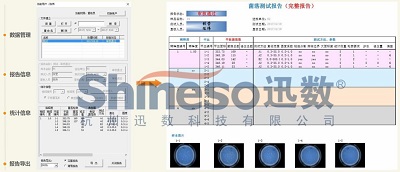
① Multi user password login, electronic signature, computer-generated operation review date;
② All operational procedures, such as images, dilution ratios, statistical tools, parameters used, test values, correction situations, etc., are automatically recorded in the database by the computer and cannot be modified by the operator;
③ By reproducing the testing environment and process, the reviewer can trace all the operations of the operator.
Complex colony counting
Xunshu - an image segmentation method based on the level set active contour model, combines the level set method and the active contour model. In the process of minimizing the energy functional, the active contour continuously approaches the segmentation target until the evolution of the active contour line stops (the energy functional is minimized), and the segmentation is completed. It is suitable for segmentation and recognition of difficult colony images.
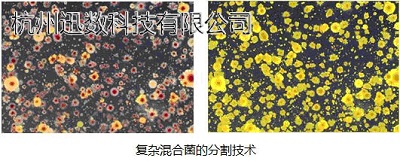
Impurity removal statistics
Impurities often exist in the process of microbial colony counting, such as unfiltered samples directly injected into culture dishes, and the presence of insoluble substances, bubbles, agar clots, etc. in the culture medium. By utilizing the morphological differences between bacterial colonies and impurities, such as size, color, contour, etc., certain conditions can be set to filter out specific impurities.
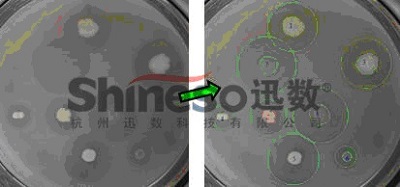
Double circle analysis
Xunshu provides specialized characteristic analysis tools for double circle problems such as antibacterial circle, transparent circle, color changing circle, and growth circle. By accurately measuring the outer circle diameter and colony diameter, the area ratio and diameter ratio of the two are automatically calculated. Automatically sort and locate corresponding colonies based on the size of the ratio, which can be used for screening antibiotics, enzyme preparations, organic acids, etc.
One click measurement of mold
The traditional fungal research experiments, such as mycelial growth rate, fungal growth amount, mycelial growth inhibition rate, and indoor toxicity determination, use the cross method to measure the colony growth diameter. Due to the spread, looseness, and irregular edge divergence of most fungal colonies, there is a large human error in measurement, resulting in low efficiency. The "one click mold measurement" module of Xunshu can instantly measure the area, circumference, length, and length of large molds by clicking once on the edge of the colony with a "magic wand".

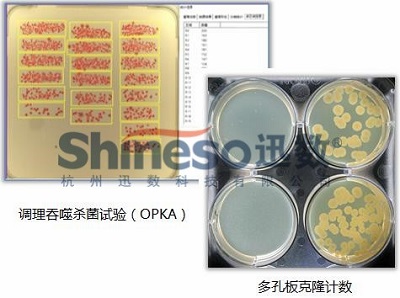
Multi regional statistical tool - suitable for OPKA, SBA, porous plates
The Xunshu multi area statistical algorithm can easily achieve synchronized one click counting of any number of areas, suitable for conditioning phagocytic bactericidal tests (OPKA) and serum bactericidal tests (SBA), as well as porous plate analysis.
Antibacterial zone measurement
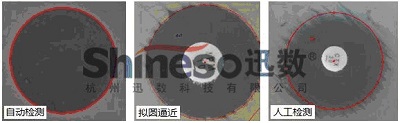
Szone multi-mode measurement technology
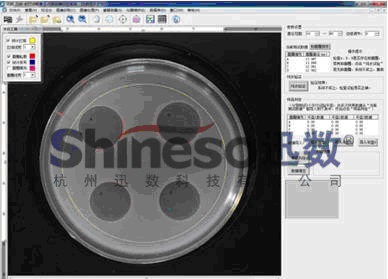
The tube disk diffusion method requires a circular and clear edge of the antibacterial zone, but there may still be situations such as unclear or broken edges in the experiment. The S-zone antibacterial zone multi-mode measurement technology uses three different high-speed algorithms to accurately extract the pixels that make up the edge of the antibacterial zone, thus completing high-precision measurement.
Antibiotic potency determination
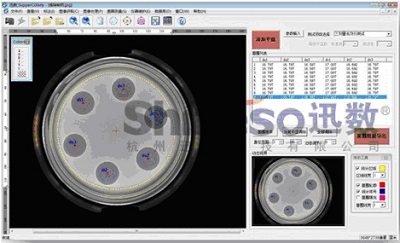
Meets the requirements of the Chinese Pharmacopoeia 2015 edition for the two dose method, three dose method, and combined calculation. High definition imaging and high-precision digital measurement ensure the accuracy of potency determination. The relative error of repetitive self check is less than 0.01%; The relative error of uniformity self-test is less than 0.05%; The accuracy of potency measurement is greater than 99.7%.
Shubatan sensitive β - lactase test
The issue of antibiotic residues has become one of the important factors affecting the safety of dairy products. In order to test whether β - lactase is added to milk, Xunshu provides a fast measurement and intelligent judgment software, which intelligently judges whether β - lactase is positive or negative through pure water verification, parallel sample detection, and average value calculation.
Main functions and technical indicators
1、 Digital imaging of bacterial colonies and inhibition zones
1. Light source
Visible light: High brightness tri color LED structured light
254nm UV: used for cavity disinfection and UV mutagenesis
2. Light path and lighting control
Fully enclosed dark box: eliminating environmental stray light interference
Upper light source: scene style 360 ° flexible shadowless lighting
Lower light source: Crystal Sharp floating dark field illumination
Up light, down light, dual light, UV, freely switch
Color temperature adjustable (3500K-8500K), light intensity adjustable
3. Optoelectronic conversion
High definition industrial fixed focus lens: focal length 8mm, resolution 150 lp/mm
Professional CMOS camera: 1/2.33 "inch color CMOS sensor, 16 million pixels C-Mount
2、 Colony analysis module
1. Basic colony counting function
Type of petri dish: pouring, coating, membrane filtration, spiral petri dish, 3M paper sheet, porous plate
One click intelligent counting (6 modes): flat sensing mode, three-dimensional sensing mode, small colony priority, large colony priority, same color bacteria priority, culture medium removal mode
Whole dish colony count: Count the total number of colonies and display them classified by 25 sizes
Region selection statistics: You can choose circular, rectangular, or arbitrarily delineated regions for statistics
Diameter classification statistics: Set the diameter range and count colonies of specific sizes
Mouse click statistics: Quickly mark and add colonies, suitable for counting colonies at the edge of culture dishes
Colony adhesion segmentation: Automatically segment colonies that adhere to each other, and users can choose to segment or not segment chain colonies
2. Advanced colony counting function
? Spiral colony statistics: spiral colony statistics: automatically count spiral plates according to FDA standards, and support exponential mode, slow exponential mode, uniform mode, proportional mode, lawn mode, etc. Compatible with SBI in the United States and IUL in Spain. Support the entry and exit inspection and quarantine industry standard SN/T 2098-2008
Dynamic adjustment statistics: The statistical results can be dynamically adjusted and corrected to quickly obtain the statistical effect.
Deviation estimation statistics: suitable for situations with multiple and complex colony colors.
Level set multi model algorithm: search operation, obtain * image segmentation effect, adapt to background changes in the culture medium
Specific colony statistics: Identify specific colonies based on their color, size, and contour characteristics
Trans statistics: suitable for extremely complex colony types and uniform culture medium background
Statistics of high adhesion bacteria: suitable for segmentation calculation of multiple adhesion bacteria
Removal of miscellaneous bacteria and impurities: Automatic removal of miscellaneous bacteria and impurities based on differences in morphology, size, and color
3. Grid filter membrane and 3M test piece
Black solid line grid with one click statistics
3M total bacterial count test piece, 3M * test piece: one click statistics
3M Escherichia coli test strip, 3M Escherichia coli/Escherichia coli rapid test strip: one click statistics+manual selection
4. Typical bacterial screening
Single color classification statistics: Select specific bacterial colonies based on color accuracy, diffusion, colony size, and contour features
Multi color automatic clustering: automatically distinguish 24 different colored colonies based on color clustering accuracy
Multi color screening: screening 1-8 color colonies at once
Transparent circle characteristic analysis: suitable for antibacterial circle, hydrolysis circle, discoloration circle, calcium dissolution circle, hemolysis circle, oil discharge circle, phosphorus dissolution circle analysis
Double color circle automatic filtering
5. Description of colony characteristics
Bacteria and yeast: features such as color, size, shape, surface morphology, edge, gloss, transparency, etc., intelligently described and sorted
Mold and actinomycetes: features such as front color, back color, size, surface morphology, edges, texture, etc., intelligently described and sorted
6. Special analysis
Serial statistics: suitable for complex bacterial colonies with uneven background in the culture medium
Parallel statistics: suitable for porous plate, OPKA, SBA analysis
7. Advanced Tools
Grid Clearing: Eliminating background interference in the filter membrane grid
Manual counting correction: adding or deleting colonies
Exclude contaminated areas: Use the mouse to outline any contaminated area and automatically remove the bacterial count from the contaminated area
Background text elimination: automatically eliminates marker interference
Background stripe removal: automatically eliminates interference from stains on the culture dish
Artificial adhesion segmentation: manually segmenting multiple adhesive colonies
Parameter automatic conversion: Input the diameter of the culture dish and sample dilution to achieve automatic conversion
Text and graphic annotation: various drawing tools and embedded Chinese and English text
8. Calibration and Measurement
Instrument calibration: The instrument comes with built-in calibration and manual correction calibration
One click rapid measurement: One click determination of large bacterial colonies, suitable for single colony analysis of fungi and actinomycetes
Automatic measurement of the entire dish: analysis of the equivalent diameter, area, length, circumference, and roundness of the entire dish colony
Manual precise measurement: length, angle, radian, area, arc, any curve
9. Image processing
Image adjustment: grayscale image and negative phase diagram conversion; Brightness, contrast, and saturation adjustment; RGB adjustment
Image enhancement: sharpening, adaptive enhancement
Image filtering: median filtering, high pass filtering, Gaussian filtering, low-pass filtering, queue filtering, high pass Gaussian filtering
Edge detection: Sobel operator, Robert operator, Laplace operator, vertical detection, horizontal detection
Morphological operations: corrosion, dilation, opening operation, closing operation
3、 Data Security and Management
1. The four tiered system architecture of "system, data, operation, and review" is divided into functions and permissions to ensure the security, integrity, and authenticity of data information
System Administrator (Top Level): Responsible for creating and managing accounts and login passwords for all operators and auditors. Ensure account and data isolation between operators and between operators and auditors.
Data Administrator (Deputy Senior): Responsible for archive management of all test data and database management of computers. Seal all approved test reports or backup and export original images and test data to ensure data integrity and security.
Operator: Responsible for testing, self checking, correcting, generating electronic reports, submitting for review, and printing reports on approved documents for culturing dish colonies.
Reviewer: Responsible for reviewing the test reports submitted by operators. Verify the data input and processing process, but have no authority to modify it; Review and return the suspicious report, and request the operator to retest it; The report that has been approved will be archived, and neither the auditor nor the operator has the right to delete it again to ensure the originality and authenticity of the data.
2. Data storage and export
Mainly based on electronic data, record: sample source, number, dilution, petri dish image, recognition effect, count value, statistical tools used, parameter settings, correction status, to ensure complete record information.
Meet quality audit requirements, and the stored electronic data can be printed and output in PDF or Excel format
3. Watermark signature technology, tamper proof technology, and intelligent reconstruction technology for testing processes to achieve effective audit tracking
4. Anti tampering technology
Adopting multi-user login management, the names of all operators and auditors are automatically recorded in the operation process and test report by the system; All operation dates and review dates are automatically generated by the computer to avoid errors or forgeries.
The entire operation process, including colony images, dish size, sample dilution, statistical tools, parameters used, total bacterial count obtained from testing, self checked and corrected total bacterial count, etc., is automatically recorded in the database by the computer and cannot be modified by the operator, providing all real data for subsequent audits.
5. Watermark signature technology
The test report with "approved" will automatically generate electronic signatures for the operator and auditor's accounts, and an anti-counterfeit "approved" watermark will be printed on the report.
6. Intelligent refactoring technology for testing process
The "reviewer" opens the "waiting for review" test record, and the computer automatically restores the entire process and testing environment of the operator, including: images of the culture dish measured at that time, test results, dish size, sample dilution, statistical tools and parameters used, total bacterial count obtained from the test, correction status
By reproducing the testing environment and testing process, the reviewer can trace all the operations of the operator, verify the accuracy of the test results, and achieve the purpose of audit tracking.
4、 Antibacterial zone analysis module
1. Multi mode measurement technology for Szone inhibition zone
Automatic detection: precise edge detection based on the contour of the antibacterial zone, suitable for clear edges and circular antibacterial zones
Quasi circular approximation: Based on the contour of the antibacterial zone, circular fitting approximation is suitable for edge rupture and non-standard circular antibacterial zones
Manual detection: Click on three points on the edge of the antibacterial zone with the mouse to form a circle, suitable for antibacterial zones with blurred edges
2. Determination of antibiotic potency
One dose method potency testing: suitable for the United States Pharmacopeia
Two dose method, three dose method, and combined calculation: suitable for the Chinese Pharmacopoeia 2015 edition
Repetitive self check: relative error ≤ 0.01%, repeated measurement accuracy ≤ 0.002mm
Uniformity self check: relative error ≤ 0.05%
Measurement difference between stations ≤ 0.2%
3. Shubatan sensitive β - lactase test
Pure water verification: Generate inhibition zones based on (A), (B), and (D), D-C≧3, B-A≦3 , The judgment system is established
Automatically detect the (A), (B), (C), and (D) inhibition zones of three parallel samples and import the data
Automatically calculate the average value of parallel experiments and intelligently distinguish the positive and negative results.
Automatic alert for invalid reports
5、 Microscopic Cell Analysis Module
1. Microscopic imaging
Microscope: Olympus CX-31 microscope
SONY 1 "inch large field of view CMOS camera, 20 million pixels, 15fps
2. Image display and conversion
Image display: Real time dynamic observation, capturing any field of view image at any time
Image observation: with functions of rotation, enlargement, reduction, mirror conversion, and local observation
Image editing: It has functions such as cutting, copying, pasting, and text input for any area of the image
3. Microscopic image processing
Adaptive enhancement: By performing resolution enhancement processing that matches the features of the original image, the image becomes clearer and the edges are more prominent, facilitating the observation and recognition of subtle structures in the image.
Image adjustment: arbitrary adjustment of image brightness, contrast, saturation, RGB color, and conversion of grayscale and negative phase diagrams
Image compensation: Various mathematical methods such as linear compensation, logarithmic compensation, Bell compensation, etc. are used to compensate for the distorted parts of the image, making the image clearer.
Image sharpening: By enhancing the high-frequency components of an image, the edges of the image become clearer.
Image smoothing: Through image smoothing processing, the background of the image is made uniform.
Image filtering: Six filtering methods, including Gaussian filtering, low-pass filtering, and median filtering, effectively improve image clarity.
Edge detection: Two detection methods and three operators combined with multiple detection options can more accurately extract image contours.
Morphological processing: Nonlinear mathematical morphological processing such as corrosion, expansion, opening, and closing.
4. Target measurement
Calibration: It has the function of online calibration of the system to achieve precise measurement (default calibration values are built into the system)
Measurement function: online measurement of particle diameter, length, curvature, angle, any curve, area, etc
5. Particle statistics
Automatic statistics: Automatically count particles and display morphological parameters such as area, perimeter, diameter, roundness, etc. of each particle
Regional statistics: You can choose any shape area such as rectangle, circle, umbrella, etc. for statistics
Diameter classification statistics: Set the diameter range and count particles of specific sizes
Color recognition statistics: Filter specific particles based on chromaticity, brightness, and saturation
Mouse click statistics: Adding or deleting particles with mouse clicks is convenient and fast
Adhesive segmentation processing: According to user needs, particles that adhere to each other can be automatically or manually segmented
Multiple statistical algorithms: using multiple segmentation algorithms, suitable for particle statistics with different backgrounds
Diversified book statistics: comprehensive statistics of multiple microscopic images
Parameter automatic conversion: Based on the statistical area and sample dilution, achieve automatic conversion
6. Drawing and Annotation
Drawing: You can draw lines, rectangles, circles, and any curves as needed for the opened image
Text editing: Text editing of opened images
Annotation: It is convenient to annotate lines and angles
6、 Instrument specifications and configuration
MF4 multifunctional all-in-one machine host
Olympus CX-31 microscope, camera adapter
20 million pixel 1-inch microscope camera
Bacterial colony analysis software, automatic inhibition zone measurement software, antibiotic potency determination software, sulbactam sensitive β - lactam enzyme testing software, microscopic analysis software
Integrated computer: dual core four thread CPU/4G memory/1T hard drive/DVD burning/21.5 'high-definition screen, Windows 7 system or above
Similar Product Recommend