-
E-mail
1119594485@qq.com
-
Phone
15152325661
-
Address
95-6 Tongtai Avenue, Jinhu County
Product Categories
Jinhu Tianxiang Instrument Co., Ltd
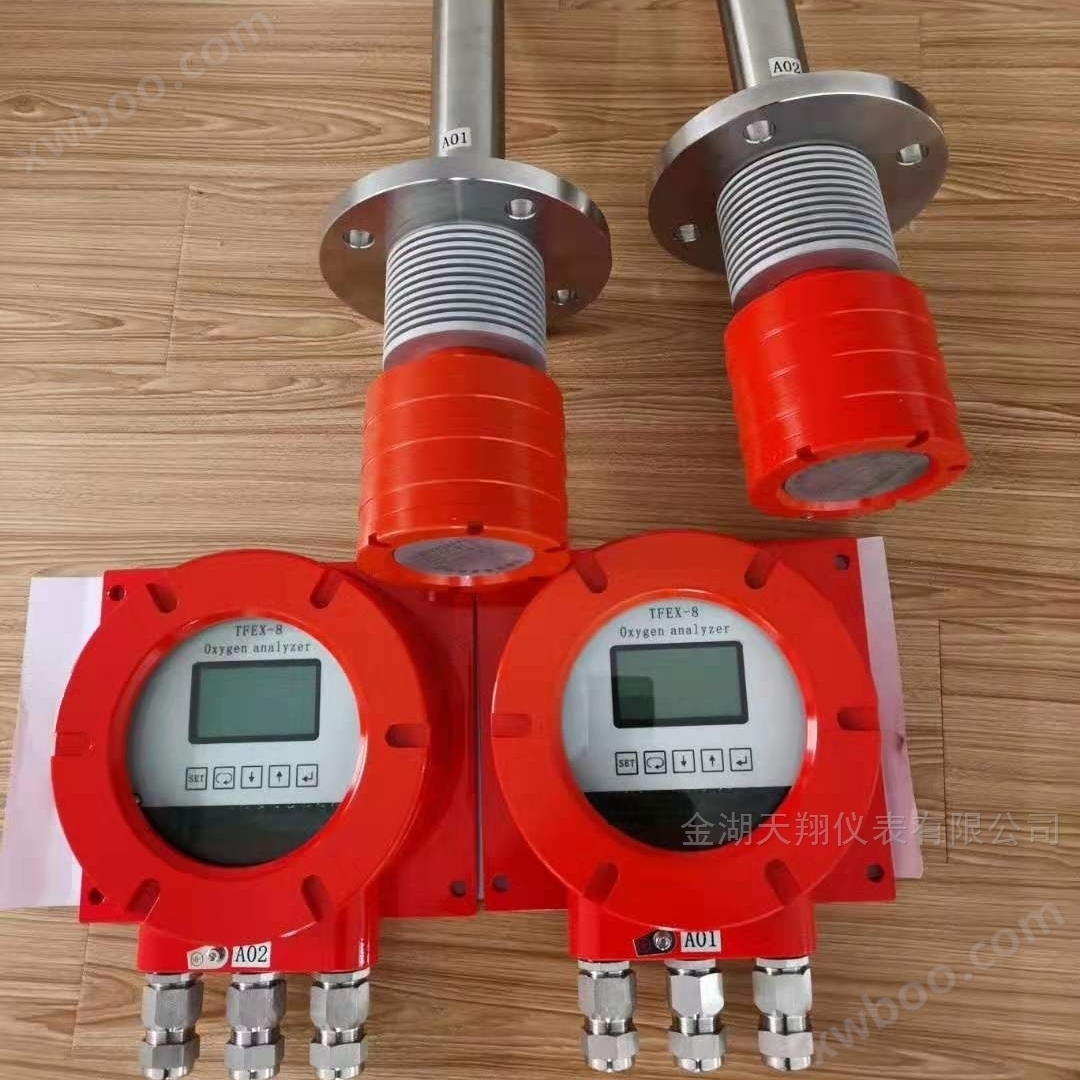


Zirconia oxygen content analyzer
NegotiableUpdate on 01/22
- Model
- Nature of the Manufacturer
- Producers
- Product Category
- Place of Origin
Overview
The zirconia oxygen content analyzer is provided by Jinhu Tianxiang Instrument Co., Ltd. This product can quickly and accurately detect and analyze the flue gas content generated by combustion equipment such as boilers, kilns, and heating furnaces during the combustion process, in order to achieve low oxygen combustion control, energy conservation, and reduce environmental pollution.
Product Details
Zirconia oxygen content analyzer--Jinhu Tianxiang Instrument Co., Ltd. Quality is the life of the enterprise, and every product is a masterpiece of craftsmanship!
Oxygen measurement principle of zirconia oxygen probe
The conductive mechanism of zirconia: The electrolyte solution conducts electricity through ions, and solid substances with ion conductive properties are called solid electrolytes. Solid electrolytes have an ionic crystal structure that relies on holes to make ions move and conduct electricity, similar to the mechanism of hole conduction in P-type semiconductors.
Pure zirconia (ZrO2) is non-conductive and doped with a certain proportion of low-priced metals as stabilizers, such as calcium oxide (CaO2), magnesium oxide (MgO), and yttrium oxide (Y2O3), which have high temperature conductivity and become zirconia solid electrolytes.
Why does zirconia have high ionic conductivity after adding stabilizers?
This is because in the ZrO2 mixture mixed with a small amount of CaO2, during the crystallization process, calcium ions enter the cubic crystal and replace zirconium ions. Due to the+4 valence of zirconium ions and the+2 valence of calcium ions, a calcium ion entering the crystal only brings in one oxygen ion, while the displaced zirconium ion brings out two oxygen ions. As a result, one oxygen ion hole is left in the crystal. For example, zirconia with a molar fraction of 85% zirconia and 15% calcium oxide (ZrO2) 0.85 (CaO2) 0.15 has a value of 7. A 5% molar fraction of oxygen ion vacancies has become a good solid electrolyte for oxygen ions.

On both sides of a high-density zirconia solid electrolyte, porous platinum layers with a thickness of several micrometers to tens of micrometers are made by sintering as electrodes, and platinum wires are welded on the electrodes as leads to form an oxygen concentration cell. If a reference gas (air) is introduced to the left side of the cell, the oxygen partial pressure is p0; if a measured gas is introduced to the right side of the cell, the oxygen partial pressure is p1 (unknown).
Assuming p0>p1, at high temperatures (650... 850 ℃), oxygen will diffuse from the side of p0 with higher partial pressure to the side of p1 with lower partial pressure. This diffusion is not due to oxygen molecules passing through zirconia from P0 to P1, but rather the process of oxygen molecules dissociating into oxygen ions and passing through zirconia.
At a high temperature of around 750 ℃, under the catalytic action of the platinum electrode, a reduction reaction occurs on the P0 side of the battery. One oxygen molecule takes 4 electrons from the platinum electrode and becomes two oxygen ions (O2-) entering the electrolyte, that is, O2 (P0)+4e → 2O2-P0. The platinum electrode on the P0 side becomes positively charged due to the large amount of electrons given, and becomes the positive or anode of the oxygen concentration battery. After entering the electrolyte, these oxygen ions move forward through the holes in the crystal to reach the platinum electrode on the right side, where oxidation reactions occur on the P1 side of the battery. Oxygen ions release electrons on the platinum electrode and combine to form oxygen molecules, which precipitate as: 2O2-4e → O2 (P1)
The platinum electrode on the P1 side becomes negatively charged due to the large amount of electrons obtained, making it the negative electrode or cathode of the oxygen concentration cell.
In this way, a potential is formed on the two electrodes due to the accumulation of positive and negative charges, which is called the oxygen concentration electromotive force. When two electrodes are connected to form an electrical circuit using wires, electrons on the negative electrode will flow through the external circuit to the positive electrode, and then supply oxygen molecules to form ions, resulting in current passing through the circuit. The magnitude of the oxygen concentration difference electromotive force is related to the oxygen concentration in the gases on both sides of the zirconia solid electrolyte.
Working principle of zirconia oxygen sensor
On both sides of the zirconia electrolyte (ZrO2 tube), porous platinum (Pt) electrodes were sintered, and the battery body was measured to be divided into three layers: platinum (electrode) - zirconia (electrolyte) - platinum (electrode). Platinum electrodes are porous. The flue gas enters one side of the measuring cell through a filter or a calibration gas through a conduit, while the other side is the reference air (containing 20.60% oxygen).
When two gases with different oxygen concentrations act on the measuring cell, a logarithmic potential is generated (the larger the difference in oxygen concentration between the two sides, the larger the potential signal). Millivolt signals are converted into standard currents of 0-10mA or 4-20mA by an oxygen analyzer. This current is output from the terminal of the oxygen analyzer.
The working temperature of the battery is set to a constant temperature above 650 ℃. In order to maintain a constant working temperature, a K-type thermocouple is used to measure the working temperature of the battery, and the heating voltage of the heater is adjusted by the temperature controller inside the oxygen analyzer.
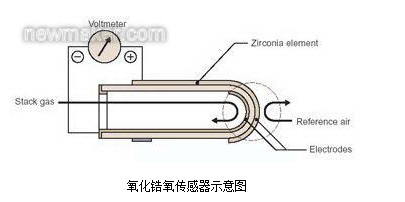
When measuring the flue gas temperature above 700 ℃, the heater and temperature measuring thermocouple are omitted from the sensor composition.
In an ideal state, when the concentration of the measured flue gas is the same as that of the reference gas, the output potential E value is 0 mV. However, in practical applications, the actual conditions and on-site conditions of the zirconium tube are not ideal. The actual zirconium tube in the story deviates from this value. In fact, the potential output by a zirconium tube with a certain oxygen content is the sum of the theoretical value and the background potential. We call the potential value output by the zirconium tube under no concentration conditions the background potential or zero potential. The magnitude of this value varies at different temperatures and changes with the extension of the zirconium tube's service life. Therefore, if this situation is not addressed, it will seriously affect the accuracy of the entire oxygen analyzer and the lifespan of the probe.
Structure and types of zirconia oxygen analyzer
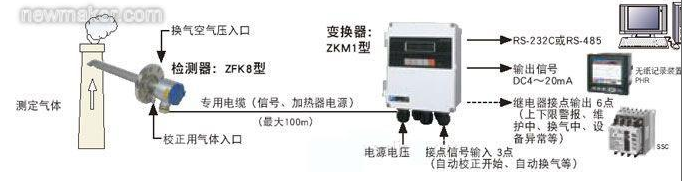
The composition of zirconia oxygen analyzer is composed of oxygen sensor (also known as oxygen probe, oxygen detector), oxygen analyzer (also known as transmitter, transmission unit, converter, analyzer), dust prevention device, thermocouple, heater, standard gas conduit, junction box, and shell.
The dust prevention device consists of a dust cover and a filter, which can prevent dust in the flue gas from entering the interior of the zirconia tube, protect the zirconia tube components from pollution, and serve as a buffer gas sample.
The zirconia tube component is the core component of the oxygen probe, which generates an oxygen concentration potential signal. Zirconia tube is a ceramic metal oxide, and severe vibration must be avoided during use to avoid damaging the zirconium tube components.
Thermocouples are used for constant temperature control of probes with built-in heaters, and are also components for measuring the temperature of the measured gas in boiler and kiln flues, providing a temperature signal for oxygen calculation.
The function of the heater is to provide the temperature required for the normal operation of zirconia solid electrolyte components, so that they can also work normally in the tested flue gas environment below 600 ℃.
The oxygen potential signal and thermocouple temperature signal from the oxygen probe are amplified and sent to the A/D conversion circuit for data processing together with the correction coefficient to obtain the percentage of oxygen content. At the same time, the system can display oxygen potential, probe temperature, and correction coefficient values, and perform constant temperature control on the heating electric furnace of the zirconium tube, supplemented by thermocouple breakage, overtemperature protection, and thermocouple reverse protection to ensure reliable operation of the system.
According to different detection methods, zirconia oxygen probes are divided into two categories: sampling detection oxygen probes and direct insertion oxygen probes.
Sampling detection oxygen probe
The sampling and detection method is to introduce the measured gas into the zirconia detection chamber through a guide tube, and then heat the zirconia to the working temperature (above 750 ℃) through a heating element. Zirconia is generally tubular, and porous platinum electrodes are used as electrodes. Its advantage is that it is not affected by the temperature of the gas being detected. By using different guide tubes, the oxygen content in gases at various temperatures can be detected. This flexibility is applied in many industrial online detections. Its disadvantage is slow response time; Complex structure, easily affecting detection accuracy; When there are many impurities in the detected gas, the sampling tube is prone to blockage; Porous platinum electrodes are susceptible to corrosion from sulfur, arsenic, and other gases, as well as blockage by fine dust, leading to failure; Heaters are usually heated with electric furnace wires and have a short lifespan.
When the temperature of the gas being tested is low (0 ℃~650 ℃), or when the gas being tested is relatively clean, it is appropriate to adopt a sampling detection method, such as nitrogen generator oxygen measurement, laboratory oxygen measurement, etc.
Zirconia oxygen content analyzerDirect insertion detection oxygen probe
Direct insertion detection is a method of directly inserting zirconia into a high-temperature gas to detect the oxygen content in the gas. This detection method is suitable for detecting gas temperatures between 700 ℃ and 1150 ℃ (special structures can also be used for high temperatures up to 1400 ℃). It uses the high temperature of the gas to reach the working temperature of zirconia without the need for an additional heater. The key technology of direct insertion oxygen probe is the high-temperature sealing of ceramic materials and electrode issues.
Due to the need to directly insert zirconia into the detection gas, there are high requirements for the length of the oxygen probe, with an effective length of about 500mm to 1000mm, and a special environmental length of up to 1500mm. In addition, there are high requirements for detection accuracy, working stability, and service life. Therefore, direct insertion oxygen probes are difficult to use the overall zirconia tubular structure of traditional zirconia oxygen probes, and often adopt the structure of connecting zirconia and alumina tubes with high technical requirements. Sealing performance is one of the key technologies for this zirconia oxygen probe. The current connection method is to weld zirconia and alumina tubes together, which has good sealing performance. Compared with the sampling detection method, the direct insertion detection has obvious advantages: zirconia directly contacts the gas, high detection accuracy, fast reaction speed, and less maintenance.