-
E-mail
13328052090@qq.com
-
Phone
13328055291
-
Address
1388 Chengbei Avenue, Kunshan City
Product Categories
Kunshan Jutian Instrument Equipment Co., Ltd


Test weight continuous change electronic balance scale laboratory samples
NegotiableUpdate on 01/22
- Model
- Nature of the Manufacturer
- Producers
- Product Category
- Place of Origin
Overview
Test weight continuous change electronic balance scale laboratory sample $r $n ● Timing recording function: After installing weighing software on the computer, the electronic scale continuously measures the weight change and transfers the data to the computer. The testing time period can be set arbitrarily in minutes and seconds, and a curve graph is generated from the weight change. The data is saved in an EXCEL table for easy subsequent plastic tracing, suitable for laboratory testing samples.
Product Details
Test weight continuous change electronic balance scale laboratory samples


electronic balanceProduct Description:
3 weighing units: g/ct/ozt
● Additional simple counting function
● Multi segment linear correction in the factory
● Automatic backlight
● Scale/division value
● Dimensions: 26 (L) x20 (W) x8 (H) cm
Scale pan size: Ø 11.6cm (round)/12.4 (L) x 14.4 (W) cm (square)
DC9V/150mA (220V AC)
● Optional wired external display screen (RS-232 interface cannot be selected at this time)
● Optional built-in rechargeable battery (6V/1.3Ah)
●Timer recording function: After installing the weighing software on the computer, the electronic scale will record the weighing dataContinuously measure changes in weight and transmit data to a computerOn top of that, the testing time period can be set arbitrarily in minutes and seconds, and a curve graph is generated from the change in weight. The data is saved in an EXCEL table for easy follow-up molding, suitable for laboratory testing samples.
● External USB expansion function: It has the function of external USB expansion, which can automatically generate detailed weighing records while weighing The CSV format spreadsheet (which can be opened by EXCEL application software) is saved on a USB drive for easy retrieval of weighing records through a computer in the future. Under standard storage format, the USB flash drive can store weighing date, time, serial number, and weight, and automatically generates a spreadsheet named after the date every day
● Three color alarm settings for upper and lower limits (HI, OK, LO can be set)lampreportPolice.
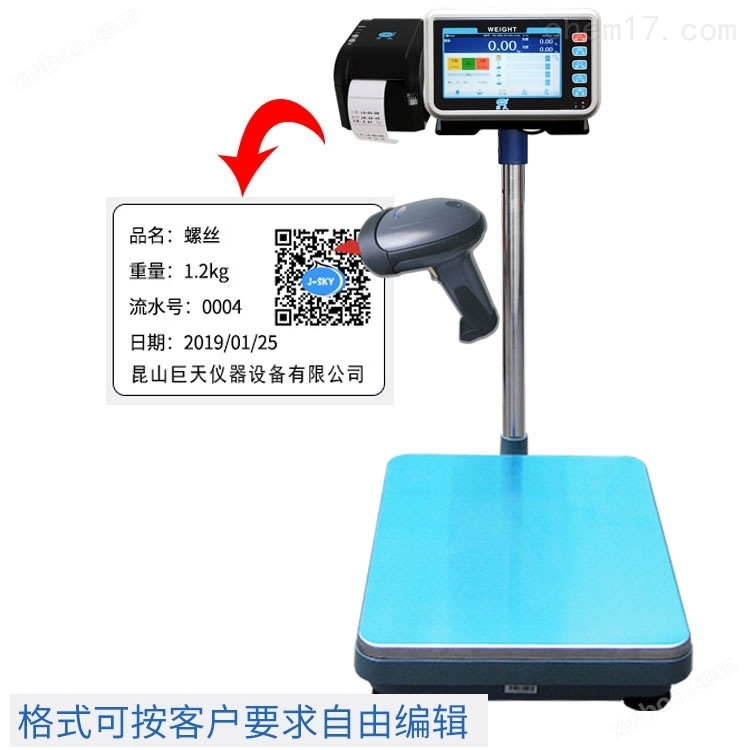
● CanoptionalBarcode printer, label printer, micro needle printer
Test weight continuous change electronic balance scale laboratory samples
electronic balanceproductSpecification Table:
JS-A5-150 |
JS-A5-150 |
JS-A5-300 |
JS-A5-600 |
150g/0.01g |
150g/0.005g |
300g/0.01g |
600g/0.01g |
JS-A5-1200 |
JS-A5-1200 |
JS-A5-1500 |
JS-A5-3000 |
1,200g/0.1g |
1,200g/0.01g |
1,500g/0.05g |
3,000g/0.1g |
The following content is for reference only:
The four performance indicators of electronic scales: gas field. When using electronic scales in daily life, the first consideration is the stability, sensitivity, accuracy, and invariance of the scale readings. The so-called stability refers to the stability of the accuracy of the balance; And sensitivity refers to the reaction speed of the balance reading, in which electronic balances have higher sensitivity than mechanical balances; Correctness refers to the accuracy of its readings; And invariance refers to the stability of the balance reading, that is, the floating range of the balance reading. The smaller the floating range, the better its invariance.
1、 Invariance of electronic balance readings:
The invariance of electronic balance readings refers to the consistency of the measurement results obtained by measuring the same object multiple times under the same conditions. For electronic balances, there is still the invariance of the balance indication, such as controlling the repeatability and reproducibility of the electronic balance, controlling the zero position and return * of the electronic balance, and controlling the drift of the electronic balance indication at a specified time when the electronic balance is unloaded or loaded.
2、 The correctness of electronic scales:
The correctness of an electronic balance refers to the accuracy of the balance reading, which represents the ability of the balance reading to approach the true value; From the perspective of error, the correctness of a balance reflects the degree of systematic error in the displayed value of the balance.
3、 Sensitivity of electronic balance:
The sensitivity of an electronic balance refers to its ability to detect changes in the mass of an object placed on a balance plate. The sensitivity of an electronic balance can be represented by angular sensitivity, line sensitivity, division sensitivity, or numerical (division) sensitivity. For electronic scales, it is mainly represented by the division sensitivity or numerical sensitivity. The smaller the change in mass that can be detected by the balance, the more sensitive the balance is. Therefore, for electronic balances, the sensitivity of the balance is still one of the important performance indicators for judging the quality of the balance.
4、 Stability of electronic balance:
The stability of an electronic balance refers to its ability to automatically return to its initial equilibrium position after being disturbed. For an electronic balance, its equilibrium position is always represented by analog or digital indications. Therefore, once a momentary interference is applied to the electronic balance, although the indication changes, after the interference is eliminated, the balance can return to its original indication. Therefore, we call the electronic balance stable. The stability of an electronic balance is the primary criterion for its usability, and an electronic balance without stability cannot be used at all.
Similar Product Recommend