-
E-mail
taili668@vip.163.com
-
Phone
13662293686
-
Address
13D, Building A2, the Pearl River River Plaza, No. 9009, Longxiang Avenue, Longgang District, Shenzhen
Product Categories
Shenzhen Taili Instrument Co., Ltd


TABER paper and cable printing stiffness tester from the United States
NegotiableUpdate on 02/22
- Model
- Nature of the Manufacturer
- Producers
- Product Category
- Place of Origin
Overview
The American TABER paper and cable printing stiffness tester is mainly used to evaluate the stiffness and resilience of flexible materials, including paper, cardboard, plastic, metal, textiles, rubber, wires, and other stiffness tests.
Product Details
TABER TAIBOR, USAPaper cable printingStiffness meter
description
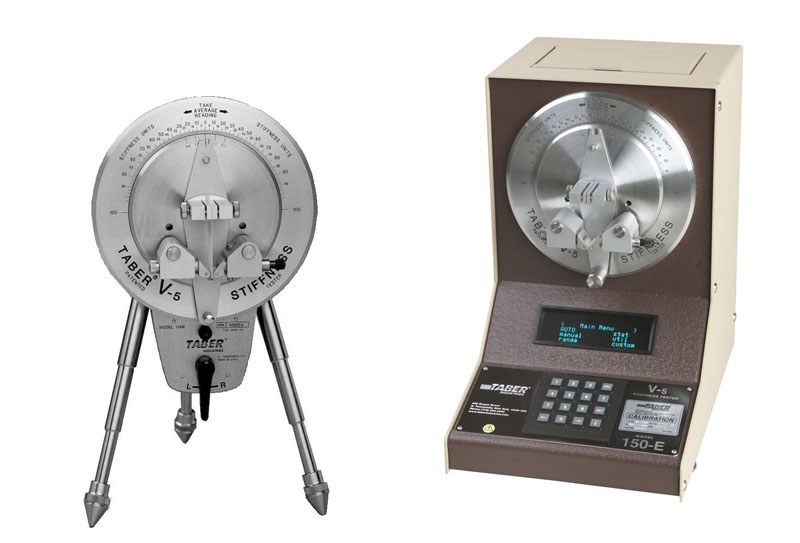
The TABER V-5 stiffness meter is a bidirectional swing measurement structure. Sensitive measurement is an important instrument for measuring the stiffness and elasticity of materials. Nine different ranges allow measurement from very soft materials such as glass paper or thin metal foil to very hard objects such as plastic.
For ranges 2-9, the sample is fixed by the fixture on the pendulum. The lower end face of the gripper is located at the center of rotation of the pendulum.
The two jaws of the fixture are adjustable, and the sample can be positioned at the center position regardless of the thickness of the material. This ensures the length and bending angle of the sample testing, ensuring good repeatability of the test results. Apply force to the lower end of the specimen through a pair of rollers. The roller is installed on the drive plate behind the pendulum, pushing the test sample to deflect from its vertical position. During the deflection process, the pendulum increases the torque on the specimen. When the marking is aligned with the drive plate marking (7 1/2 ° or 15 °), the displayed reading is the stiffness value corresponding to the dial at this time. The final reading will depend on the selected range and the corresponding scaling factor. The instrument displays the torque (in grams per centimeter) applied to the sample at this time.
Depending on the stiffness value of different materials, range weights can be applied on the pendulum. For extremely light and soft materials, the compensating weight is installed at the top of the pendulum. 500, 1000, and 2000 range weights are installed at the bottom of the pendulum, necessary for harder materials. The optional 3000 and 5000 weights are necessary for ranges 7, 8, and 9.
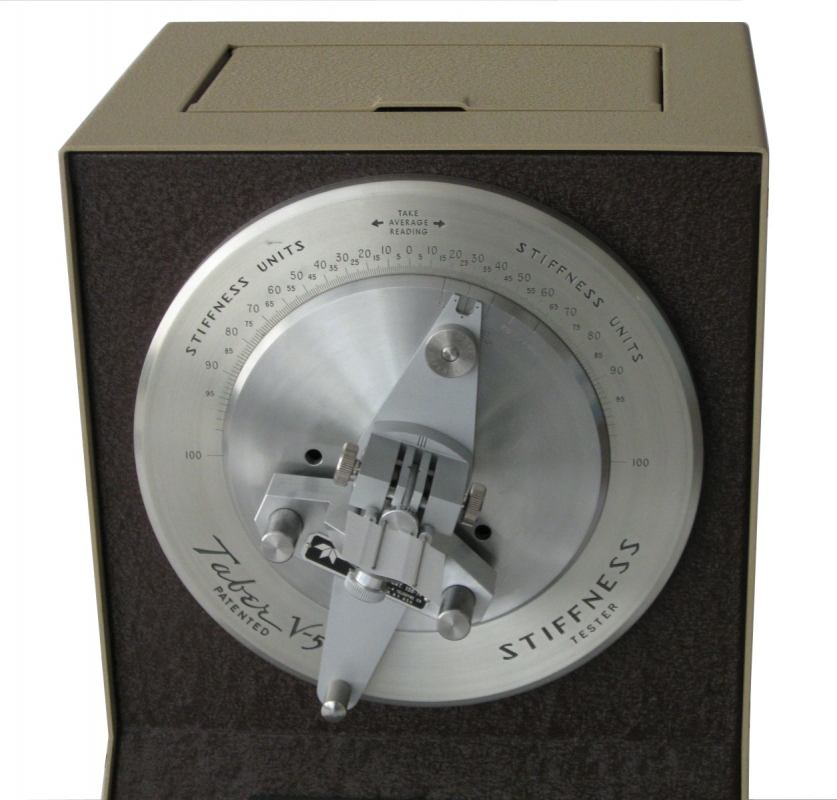
Many customers also use the TABERV-5 stiffness meter to evaluate the stiffness of wires and cables. There is a "V-shaped groove" on the fixture for this test. Suggest a sample length of 70mm and a diameter of 3mm to 8mm, carefully place it in the center of the slot, and do not compress or deform it. For cables smaller than 3mm, it is recommended to place them in a flat area of the fixture. Curved samples mayinterferenceSetting and measuring should be avoided. In addition, the test results can only be used for comparing different batches and materials
Optional models
Taber stiffness tester -150-E type(115 / 230V,50 / 60Hz)
The 150-E is equipped with an onboard computer that can automatically calculate and record test data. Automatically calculate the stiffness value based on the selected range, without the need for manual multiplication of proportional coefficients. This instrument can also calculate the mean, standard deviation, and large/small values. Using a 16 key keyboard, the operator can choose their own direction, angle, and number of rotations. The instrument can also operate in manual mode, similar to model 150-B
By selecting an output port, test data can be printed or downloaded to a PC. It can store up to 1000 readings.
Taber stiffness tester 150-B(110V, 60Hz)
150-B is a manually operated instrument based on the TABER V-5 stiffness meter, installed on a tripod. The 150-B is lightweight and easy to carry. The circuit part is sealed inside a sturdy casing. 150-B requires users to manually record stiffness test data, average readings, and manually multiply the proportional coefficient to calculate the results.
Note: TABER provides transformers (220V/110V) operating at 220V.
evaluate
After turning the test material to the left and right by 15 ° (or 7 1/2 °), determine the average reading. Then multiply by the proportional coefficient of the corresponding range. The measurement unit is Taber stiffness unit.
Taber stiffness unitThe torque required to bend a sample 1.5 inches wide and 5 centimeters long by 15 degrees with 0.2 grams.
The unit of stiffness is equivalent to 1 gram centimeter.
The stiffness meter is very sensitive, and material changes have an impact on the measurement. Suggest testing 5 or more samples and taking the average. The clamping method of the sample and the gap between the roller and the sample also have an impact on the measured values. Please note:
Do not bend the sample before testing
Be careful not to excessively clamp the sample
Excessive compression of the sample can reduce the thickness of the material, resulting in inconsistent and inaccurate stiffness values
Some materials may produce particles inside during the manufacturing process, which can affect the stiffness value. This must be taken into account during the testing process and tested in both directions. Suggest preparing 5 to 10 samples for testing.
test method
The following link provides a list of testing methods that meet the requirements of the Taber V5 hardness test. Please note that additional accessories may be required.
When setting up the instrument to determine the testing range for the type of material being tested, the following chart is used as a guide.
*Stiffness standard
Since 1937, TABER150 has become the standard tool for stiffness testing, and many notary agencies directly reference this machine as the standard basis for stiffness specifications.
Working principle of stiffness tester:
The important components of the Taber stiffness tester include a constant speed motor, a weighted pendulum with a style clamp that can swing freely, and an electric gearA rotating turntable. The clamping block of the sample holder is fixed at the center of the gear drive disc. During testing, the top of the sample is clamped onto two clamping blocksBetween the gaps, and its lower end is sandwiched between two adjustable fastening wheels connected to the turntable. When the power is turned on, the constant speed motor drives the gear turntable,The generated torque acts on the specimen, causing the pendulum to deviate by an angle. The stiffness value will be displayed on the dial or screen afterwards. Taber stiffness tester passedStandardizing test samples provides consistent results for research and product testing. Provide preset direction, bending angle, and round-trip timesAnd reproducible test results.
150-B traditional manual mechanical:
Easy to operate, precision tripod design, high sensitivity, lightweight and sturdy appearance. Read the stiffness value from the dial.

150-E digital display type:
Test range: 0-10000 Taber stiffness units (g.cm).
Automatically test, calculate, and record results.
Equipped with a control panel and display screen, it can set direction, bending angle, and round-trip times.
Equipped with an output port (RS-232), it can be output by a printer or downloaded to a computer.
The uninterruptible storage can store 1000 readings (with date and time).
Optional user-defined tag recognition for stored readings.
The reading can be automatically converted into a predetermined range, and it has statistical functions to automatically calculate the mean, standard deviation, large value, and small value.
Data can be printed or downloaded to a computer through an output interface.
CE certification.

Application scope of stiffness tester:
The Taber stiffness tester is used to evaluate the stiffness and resilience of flexible materials, measuring materials with a thickness between 0.1-5.5mm, such as paper, foil, metal foil, plastic foil, cardboard, rubber, and melamine board Vinyl、 Various sheets such as wires, pipes, textiles, felt, leather, etc.
The measurement range is within 0-10000 TABER stiffness units.
Stiffness and rebound
One TABER stiffness unit refers to the force exerted on a test piece that is 5 centimeters long and 3.8 centimeters wide when bent to 15 degrees by 1/5 gram of gravity. One stiffness unit is also equal to 1g. cm. The rebound force represents the elastic mass of the material and is the ratio of the basic stiffness to the initial stiffness, expressed by the following calculation formula:
Resilience=Basic stiffness ÷ Initial stiffness × 100
The 'initial stiffness' is the reading obtained immediately after the sample is bent at a fixed angle, and is usually used to compare the relative stiffness quality. The 'basic stiffness' refers to the stiffness lost due to the rearrangement of material molecules caused by the sample being continuously fixed at that angle.
TABER TAIBOR, USAPaper cable printingStiffness meter
| model | 150-B | 150-E |
| Operation method | mechanical | Mechanical/Electronic |
| power supply | 110V, 60Hz (requires a power converter to convert to 220V) | 115/230V,50/60Hz |
| Dimensions & Weight | 17”x8.8”x10”、13lbs. | 15”x10”x15.5”、25lbs. |
*Each stiffness tester has undergone ± 1% full range calibration before leaving the factory.
range |
Stiffness unit |
sample length |
Roller position |
sample size |
weight |
deflection angle |
proportionality factor |
1 |
0 - 1 |
2 centimeters |
SR Attachment |
1.5' ×1.5' |
10 units of compensation |
15° |
0.01 |
2 |
0 - 10 |
1 centimeter |
upward |
1.5' ×1.5 |
10 units of compensation |
15° |
0.1 |
3 |
10 - 100 |
5 centimeters |
down |
1.5' ×2.75' |
- - - |
15° |
1 |
4 |
50 - 500 |
5 centimeters |
down |
1.5' ×2.75' |
500 units |
15° |
5 |
5 |
100 - 1000 |
5 centimeters |
down |
1.5' ×2.75' |
1000 units |
15° |
10 |
6 |
200 - 2000 |
5 centimeters |
down |
1.5' ×2.75' |
2000 units |
15° |
20 |
7 |
300 - 3000 |
5 centimeters |
down |
1.5' ×2.75' |
3000 units* |
15° |
30 |
8 |
500 - 5000 |
5 centimeters |
down |
1.5' ×2.75' |
5000 units* |
15° |
50 |
9 |
1000 - 10000 |
5 centimeters |
down |
1.5' ×2.75' |
5000 units* |
7 1/2° |
100 |
*The optional weights (ranging from 3000-5000 TABER units) are sold separately and are used for a range of 7-9.
Optional accessories:
The accuracy and measurement range of the stiffness meter can be expanded and adjusted through the format (optional accessories), making it more widely used. The standard testing range is 10-100 stiffness units, and using a precision weight set can expand the scale to 0.1-10000 units.
The Taber 150 stiffness tester includes two models, Taber 150-B and Taber 150-E, which are mainly used to evaluate the stiffness and resilience of flexible materials.
The Taber 150 stiffness tester can be used for samples with thicknesses between 0.1-5.5mm, using materials such as paper, cardboard, plastic, metal, textiles, rubber, wires, etc.
Similar Product Recommend