-
E-mail
214260023@qq.com
-
Phone
18012485756
-
Address
Huaigu Haoting 8-1303-2, Liangxi District, Wuxi City
Product Categories
Wuxi Xigong Testing Instrument Co., Ltd
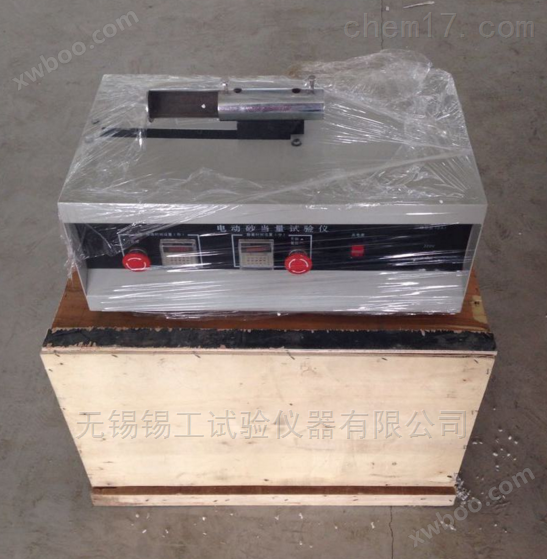
Electric sand equivalent tester
NegotiableUpdate on 01/22
- Model
- Nature of the Manufacturer
- Producers
- Product Category
- Place of Origin
Overview
Electric sand equivalent tester, according to the JTJ058-2000 (T0334-1994) standard for fine aggregate sand equivalent test, is suitable for asphalt mixtures and cement concrete. It uses natural sand, artificial sand, and stone chips with aggregate particle size not exceeding 4.75mm (circular sieve 5mm) to determine the content of cohesive soil or impurities in fine aggregates and evaluate the cleanliness of the aggregates.
Product Details
1Electric sand equivalent testerProduct Introduction:
Sand Equivalent Tester, according to JTJ058-2000 (T0334-1994) Standard for Fine Aggregate Sand Equivalent Test, is suitable for asphalt mixtures and cement concrete. It uses natural sand, artificial sand, and stone chips, with the largest aggregate particle size not exceeding 4.75mm (circular sieve 5mm), to determine the content of cohesive soil or impurities in fine aggregates and evaluate the cleanliness of the aggregates.
IIElectric sand equivalent testerTechnical Specifications:
1. Rated voltage: 220V ± 10%,~180W
2. Rated power: 90W
3. Vibration frequency: 180 times/min ± 2 times/min (motion cycle)
4. Test tube amplitude: 203mm ± 10mm
5. Counterweight piston: 1kg ± 5g
6. Dimensions: 700 × 420 × 510mm
7. Plastic test tube: inner diameter 32 ± 0.25mm, height 420 ± 0.25mm
8. Rinse tube: outer diameter 6 ± 0.5mm, inner diameter 4 ± 0.2mm
9. Total weight: 45 ± 1kg
10. Environmental temperature: ≤ 35 ℃
11. Relative humidity: ≤ 85%
3、 Operation and usage:
In order not to affect the precipitation process, the experiment must be conducted on an undisturbed horizontal platform. Check the flushing pipe mouth of the test at any time to prevent blockage. During the experiment, the temperature of the rinsing solution should be maintained within the range of 20 ± 2 ℃. Due to the tendency of plastic to become opaque under the sun, it is advisable to avoid exposing plastic containers directly to the sun. The plastic container used to hold the test solution should be cleaned thoroughly after use.
1. Use a flushing tube to suck the flushing solution into the test cylinder until the 100mm mark (approximately 80 milliliters) is reached.
2. Pour a wet sample equivalent to 120 ± 1g of dry material weight into an upright test tube using a funnel.
3. Repeatedly tap the lower part of the test tube to remove bubbles and keep the sample moist, then let it stand for 10 minutes.
4. After the sample is left to stand for 10 ± 1 minutes, block the test cylinder with a rubber stopper and fix it horizontally on the oscillator. (Note that the square head at the bottom of the test tube touches the screw.)
5. Activate the oscillator and oscillate 90 times within 30 ± 1S. When using manual oscillation, the test tube should be placed horizontally by hand, with only wrist oscillation and no need to shake the arm. The amplitude is 203 ± 25mm, and the oscillation time and frequency are the same as the oscillator. Then remove the test tube, place it vertically back on the test bench, and unscrew the rubber plug.
6. Insert the flushing tube into the test cylinder, quickly flush the aggregate attached to the wall of the test cylinder with flushing solution, then insert the flushing tube into the bottom of the test cylinder, slowly rotate the flushing tube, and at the same time, slowly raise the flushing tube at a constant speed to make the fine particles and impurities attached to the surface of the aggregate float up until the solution reaches the 380mm mark.
7. Slowly and uniformly pull out the flushing tube. When the liquid level is at the 380mm mark, cut off the flow of the flushing tube to keep the liquid level at the 380mm mark, and then let it stand for 20 minutes ± 15 seconds without disturbance
4、 Experimental steps:
1. Use a flushing tube to suck the washing solution into the test cylinder until it reaches the 100mm mark below (approximately 80ML of flushing solution is required).
2. Carefully pour a wet sample with a dry weight of 120 ± 1g into an upright test tube using a funnel.
3. Repeatedly tap the lower part of the test tube with your palm to remove bubbles and wet the sample as soon as possible, then let it sit for 10 minutes.
4. Insert a plug into the test tube, place it horizontally, and oscillate (using only wrist oscillation without shaking the arm) to maintain an amplitude of 230 ± 25mm. Shake 90 times, then place the tube vertically on the sand equivalent tester or electric sand equivalent tester test bench, and unscrew the plug.