-
E-mail
jnrise@163.com
-
Phone
15588824207
-
Address
602, Building 15, Qilu Cultural and Creative Base, No. 101 Shunfeng Road, High tech Zone, Jinan City, Shandong Province
Product Categories
Jinan Runzhi Technology Co., Ltd
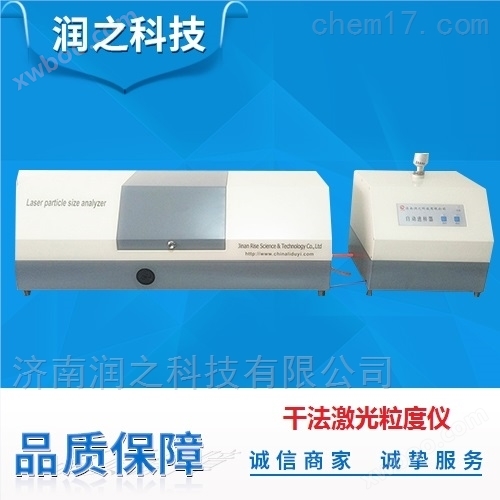
Dry laser particle size analyzer
NegotiableUpdate on 02/19
- Model
- Nature of the Manufacturer
- Producers
- Product Category
- Place of Origin
Overview
Rise-2016 dry laser particle size analyzer measurement range: 0.1-800 microns accuracy error:; amp; plusmn; 1% (standard substance D50) repeatability deviation:< amp; plusmn; 1% (standard substance D50) electrical requirements: AC 220 amp; plusmn; 10V, 50Hz, 200W Appearance size: 1000? 30 × 20mm Weight: 38KG
Product Details
Rise-2016 dry laser particle size analyzerTechnical Indicators:
1. Measurement range: 0.1-800 micrometers
2. Accuracy error:<± 1% (standard substance D50)
3. Repeatability deviation:<± 1% (standard substance D50)
4. Electrical requirements: AC 220 ± 10V, 50Hz, 200W
5. Exterior dimensions: 950 × 330 × 300mm
6. Weight: 40KG
Rise-2016 dry laser particle size analyzerWorking Principle:
The Rise-2016 model adopts the full range Mie scattering theory, fully considering the optical properties such as refractive index of the measured particles and dispersed media, and reflecting the particle size distribution data of the particle group based on the changes in scattering intensity of particles of different sizes at various angles.
The data calculation of particle testing is generally divided into two methods: unconstrained fitting inversion and constrained fitting inversion. Constrained fitting inversion assumes that the particle population follows a certain distribution pattern before calculation, and then uses this pattern to invert the particle size distribution. This type of operation is relatively simple, but due to the inevitable deviation between the assumptions made in advance and the actual situation, the test data obtained by constrained fitting cannot truly reflect the actual particle size distribution of the particle group.
Unconstrained fitting inversion means that no assumptions are made about the particle population before testing, and the particle size distribution of the particle population is accurately calculated directly through light intensity. This calculation is based on reasonable detector design and granularity grading, which puts high demands on the equipment itself. The Rise-2016 model adopts a non-uniform cross three-dimensional fan-shaped matrix detector array and reasonable particle size grading, which can accurately measure the particle size distribution of particle groups.
Rise-2016 typeTechnical features:
The foundation of stable testing: Only when the system can provide stable optical signals can the stability of test data be fully guaranteed. The Rise-2016 model uses a He Ne gas laser light source with a wavelength of 0.6328 microns, short wavelength, narrow linewidth, good stability, and a service life of over 25000 hours, which can provide stable laser source signals for the system.
The guarantee of reliable data: To ensure the reliability of test data, the first step is to design the signal detection system reasonably. The quality of the dispersion effect of the tested sample is another decisive factor in obtaining the true results.
Detector: The photoelectric detection system is designed with high sensitivity, with one main detector and multiple auxiliary detectors arranged in a non-uniform cross three-dimensional fan-shaped matrix. The maximum detection angle reaches 105 degrees, fully ensuring the comprehensiveness of signal detection.
Optical path: Adopting a range design, converging light path * reduces the Fourier lens group, making the measurement range wider, resolution higher, and optical path adjustable.
Powerful analysis software:
The PADMAS Particle Diameter Measure&Analysis System has powerful functions, and test data can be processed through averaging, statistics, comparison, and pattern conversion. It has various formats such as differential distribution, cumulative distribution, standard grading, R-R distribution, custom grading, target grading, and quantity distribution. The default grading is 130 levels within the range of 0.02~2000 microns, and the grading can be customized within the range of 1~130 levels. The test report includes particle size distribution graphs and particle size data charts, as well as characteristic parameters such as D10, D50, D90, average particle size, and specific surface area. There are four custom parameters that can be entered as needed, and weight specific surface area and volume specific surface area can be interchanged. Granular data can be saved to EXCEL. Supports printing test reports in both Chinese and English formats. The header and footer can be modified as needed, and there is a print preview function. It can save granularity distribution graphics and granularity data charts in image or PDF format for interactive use with WORD. Other processing functions can be added according to user needs. Easy to operate: Standard, quantitative, and simple operations can be mastered proficiently in a short period of time, and the testing data process can be completed within 1 minute.
Strong visibility: The testing software interface is user-friendly, the testing process is clear and visible, with instant refresh and strong visibility. The instrument operation status and test data fluctuation can be observed at any time, and the authenticity and reliability of the measured data can be analyzed. The operation keys are all located on the intelligent touch panel, providing standard, quantitative, and simple operations, effectively reducing testing time and lowering the requirements for operators.
Equipment maintenance: Comprehensive technical training and detailed user manuals, software online assistance enable operators to operate accurately, solve problems, and troubleshoot.
Based on the physical and chemical properties of the sample, such as density, anisotropy, brittleness, magnetism, toxicity, flowability, agglomeration, solubility, and physical and chemical reactions, we have developed a scientific, systematic, and complete dispersion testing plan, which will be provided to users along with the instrument. We not only sell instruments, but also provide decentralized testing solutions.
Rise-2016 hardware introduction:
Hardware design *, produced according to Q/01RZ01-2004 standard, with professional manufacturing of components, stable and reliable performance, and no vulnerable parts.
Dispersion method
Rise-2016 is a high-performance instrument. The system consists of a laser particle size analyzer, an automatic dry dispersion system, an oil-free air compressor, an efficient condenser, and other components. In the dry state, the sample is uniformly transported to the high-pressure airflow through an automatic dry powder sampler, and continuously sprayed at high speed into the disperser under the drive of the high-pressure airflow. At the outlet of the disperser, the sample has been fully dispersed, and after passing through the laser beam, it enters the collector. At the same time, the computer immediately displays the particle size distribution information.
1. Dry dispersion does not require any dispersants or solvents. The dispersion principle is shown in the following figure
Friction induced shear force generated by the friction of the dispersing tube, collision between particles, and collision between particles and the dispersing tube wall
2. Adopting an oil-free air compressor, coupled with an efficient condenser, to ensure the production of pure compressed air;
3. Instantaneous dispersion and measurement, fast testing accuracy, high analysis efficiency, completed within one minute from sample injection to result output;
Similar Product Recommend