-
E-mail
985854845@qq.com
-
Phone
18369889886
-
Address
Quanpu Town Industrial Zone, Liangshan County, Jining City, Shandong Province
Product Categories
Liangshan Liulijing Second hand Equipment Co., Ltd

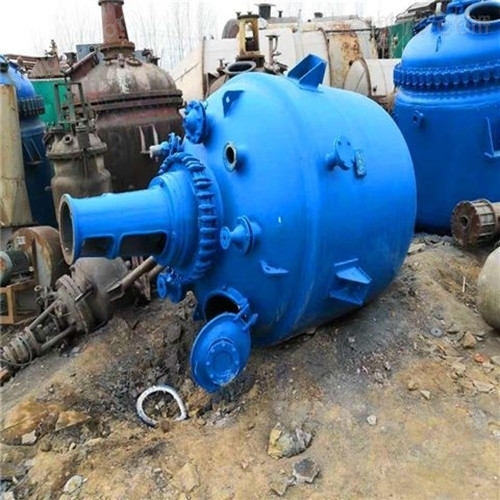
Second hand stainless steel mixing tank price
NegotiableUpdate on 01/21
- Model
- Nature of the Manufacturer
- Producers
- Product Category
- Place of Origin
Overview
Second hand stainless steel mixing tanks, also known as water phase tanks, are widely used in industries such as coatings, pharmaceuticals, building materials, chemicals, pigments, resins, food, and scientific research. This device can be made of materials such as carbon steel and stainless steel according to the process requirements of the user's product, and equipped with heating and cooling devices to meet different process and production needs. The heating forms include jacket electric heating and coil heating. The equipment has a reasonable structural design, advanced technology, durability, and is easy to operate and use. It is an ideal chemical equipment with low investment, fast production, and high returns.
Product Details
Second hand stainless steel mixing tank price
Mixing tanks, also known as water phase tanks, are widely used in industries such as coatings, pharmaceuticals, building materials, chemicals, pigments, resins, food, and scientific research. This device can be made of materials such as carbon steel and stainless steel according to the process requirements of the user's product, and equipped with heating and cooling devices to meet different process and production needs. The heating forms include jacket electric heating and coil heating. The equipment has a reasonable structural design, advanced technology, durability, and is easy to operate and use. It is an ideal chemical equipment with low investment, fast production, and high returns.
Second hand stainless steel mixing tank price
product structure
Structure of mixing tank: The mixing tank consists of a mixing tank body, a mixing tank cover, a mixer, a support, a transmission device, a shaft seal device, etc. Heating or cooling devices can also be configured according to process requirements.
The materials used for the mixing tank body, mixing tank cover, mixer, shaft seal, etc. can be made of carbon steel or stainless steel according to different process requirements. The mixing tank body and mixing tank cover can be connected by flange sealing or welding. The mixing tank body and mixing tank cover can be equipped with process pipe holes for feeding, discharging, observation, temperature measurement, pressure measurement, steam distillation, safety venting, etc. according to process requirements. The upper part of the mixing tank cover is equipped with a transmission device (motor or reducer), which drives the mixer inside the mixing tank through the transmission shaft. The shaft seal device can adopt various forms such as machine seal, packing, labyrinth seal, etc. (determined according to user needs). Due to different production process requirements of users, the mixer can be configured in various forms such as slurry, anchor, frame, spiral, etc. If there are any other requirements, please contact our factory for separate design and production.
stirring shaft
The power output of the electric motor in the mixing equipment is transmitted to the mixer through the mixing shaft, so the mixing shaft must have sufficient strength. At the same time, the mixing shaft not only needs to be connected to the mixer, but also needs to pass through the shaft seal device, bearings, couplings and other parts, so the mixing shaft should also have a reasonable structure, high machining accuracy and fitting tolerance.
According to the support situation, the mixing shaft can be divided into cantilever and single span types. Cantilever mixing shafts do not have intermediate or bottom bearings inside the mixing equipment, making maintenance and repair convenient. Especially for biological, food, or pharmaceutical mixing equipment with high cleanliness requirements, they reduce the number of components inside the equipment and should be preferred.
Internal components
Including baffles, coils, guide tubes, gas distributors, etc.
To eliminate the swirling phenomenon of the liquid in the mixing container and achieve uniform mixing by stirring the liquid up and down, it is usually necessary to add a baffle in the mixing container. Generally, the width of the baffle is about 1/12~1/10 of the inner diameter of the container. The accessories in the equipment, such as thermometer, heat transfer coil or various supports, can also play a role of baffle, but the "full baffle condition" is often not achieved. Generally, when the number of baffles is increased to measure their width, the power consumption will also increase, but when it reaches a certain value, the power consumption will not increase again. This condition is called "full baffle condition".
In the mixing container, the fluid can flow towards the mixer in various directions, and the length of the fluid's stroke varies. When it is necessary to control the speed and direction of the reflux, a guide tube can be used to determine the situation. A guide tube is a cylindrical structure with upper and lower openings, installed inside a container, and plays a guiding role in mixing and stirring. It can improve the stirring degree of the fluid in the container, enhance the direct shear effect of the agitator on the fluid, and create a certain amount of circulating flow, so that the fluid in the container can pass through the strong mixing zone inside the guide tube, thereby improving the mixing efficiency. After installing the guide tube, the circulation path is limited, reducing the chance of fluid short circuit. The guide tube is mainly used for guiding the flow of propeller, screw, and turbine agitators.
shaft seal
Shaft seal is an important component of mixing equipment. Shaft seals belong to dynamic seals, and their function is to ensure that the mixing equipment is in a certain positive pressure or vacuum state, preventing the escape of mixed materials and the infiltration of impurities. Therefore, not all types of shaft seals can be used for mixing equipment. In mixing equipment, commonly used shaft seals include liquid seals, packing seals, and mechanical seals.
Liquid seal
packing seal
It is an early adopted shaft sealing structure for mixing equipment, which has the advantages of simple structure, low manufacturing requirements, and easy maintenance. However, its packing is prone to wear and tear, and its sealing reliability is poor. It is generally only suitable for mixing equipment with normal pressure or low pressure, low speed, non corrosive and weakly corrosive media, and allows for regular maintenance.
Compared with packing seals, mechanical seals have the following advantages:
1. Reliable sealing, stable sealing state during operation, minimal leakage, with a leakage rate of only about 1% of the packing seal;
2. Long service life, generally up to 1-2 years or longer in oil and water media, and can work for more than half a year in chemical media;
3. The friction power consumption is low, and its friction power is only 10-50% of that of the packing seal;
4. The shaft or sleeve is basically not worn;
5. Long maintenance cycle, automatic compensation after end face wear, generally does not require frequent maintenance;
6. Good anti vibration performance, insensitive to the vibration and deflection of the rotating shaft, as well as the deviation of the shaft from the sealing chamber;
7. Widely applicable, it can be used for sealing high temperature, low temperature, high pressure, vacuum, different rotation frequencies, as well as various corrosive media and abrasive media.
It is precisely because of the above advantages of mechanical seals that they have been widely used in mixing equipment.
Similar Product Recommend