-
E-mail
19mro@19mro.com
-
Phone
13916696061
-
Address
Room 1408, Jincheng Building, No. 511 Tianmu West Road, Jing'an District, Shanghai
Product Categories
Shanghai Huifen Electronic Technology Co., Ltd
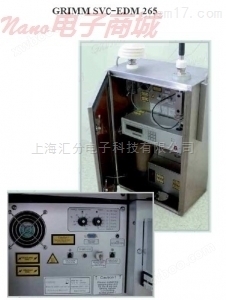
GRIMM SVC-EDM 265 Environmental Dust Monitor
NegotiableUpdate on 01/21
- Model
- Nature of the Manufacturer
- Producers
- Product Category
- Place of Origin
Overview
GRIMM SVC-EDM 265 Environmental Dust Monitor
Product Details
The GRIMM SVC-EDM 265 standalone environmental dust monitor is used to measure three different PM values and concentrations of semi volatile compounds (SVC). It can be used to measure PM10, PM2.5, and PM1. In addition, it can also measure the mass fraction of semi volatile compounds in particulate matter in the ambient air.
Advantages and concentration of semi volatile compounds (SVC)
fully automatic
Outdoor stainless steel casing
The casing includes automatic ventilation and
Heating system GRIMM SVC-EDM 265
3 different PM values
Semi volatile substance analysis
Automatic dehumidification
Particle size (optional)
Relative humidity sensor
Air temperature sensor
Air pressure sensor
GESYTEC protocol
Data storage record card
RS-232 port
Meteorological parameters (optional)
Application
Environmental monitoring station
Activity PM value monitoring
Measurement of aerosol particle size
Monitoring of hazardous areas
Semi volatile substances affect different PM
Ratio of values
Concentration of semi volatile substances
Structural benefits:
Active shell structure
No need to cover the protective shed
The system integrates multiple functions into one
Nano sensors can be placed inside (optional)
Weather sensors can be placed inside (optional)
Can place PAH sensors
The vibration has little impact
No radioactive source
Measurement principle:
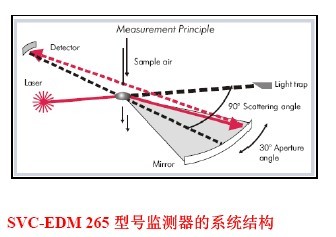
GRIMM SVC265The model dust monitor uses a flow control pump to continuously draw in air samples containing dust particles and pass them through a laser beam. The measurement of particles is based on vertical90The principle of light scattering in degrees.
Under the irradiation of laser, when particles pass through the laser beam, light scattering signals are generated. Using a converging mirror, the scattering signal is approximately90Collect scattered light in the direction of ° and converge it onto a photodiode receiver. The detected signal is amplified and provided to the pulse height analyzer, followed by particle size classification and input into each particle size channel. These particles count each6By converting seconds into corresponding mass distributions, different values can be obtainedPMValue.
The measurement results are displayed on the front panel of the instrument. The data is also stored and can be retrieved using our software to be displayed on the computerPM10,PM2.5andPM1The distribution of qualityµg/m³. Remote data access is also possible.
Why is it necessary to measure the mass fraction of semi volatile substances in the ambient atmosphere
Different studies have shown thatPM2.5The proportion of semi volatile substances inPM2.5quality20%…50%Semi volatile substances are mainly composed of sulfates, nitrates, ammonium, ammonium nitrate, etc. In order to determine the appropriatePM10andPM2.5Quality requires not only measuring non-volatile substances, but also measuring the content of volatile substances, which is very important. The use of a filter sampler in measurement may result in the loss of volatile components due to continuous sampling and gas-solid or even liquid-solid reactions. Other commonly used automatic dust monitors heat the sampling probe to prevent agglomeration. But doing so, they will lose volatile substances by heating the sample. Therefore, most measurement results are underestimated.
The loss of volatile substancesPM10It may also occur on the reference sampler, such as on hot sunny days, mainly in summer. If the support of the filter is exposed to strong solar radiation, the filter of the reference sampler may be heated.
Concentration ratio "automatic continuous monitor/FRM”Will be there0.5And approximately1This large-scale variation depends on the measurement time period (such as winter or summer) and the amount of volatile particles present in the air. Therefore, obtaining information on the quantity of volatile particles in the air during the sampling period is very useful.
For environmental dust monitors, calibration includesPMxValue is necessary. Therefore, a new, mobile, and continuously measurable instrument must be able to measure the proportion of volatile and non-volatile substances, and must also be able to provide information on a specific measurement sitePM10andPM2.5The quantity value of the proportion of semi volatile substances in. This value can be used to calculate the average correction factor of existing measurement sites/Location factor.
System Structure of VC-EDM 265 Monitor
This measurement system can provide information onEDM 365The instrument has the same measurement results, and in addition, it can also determine three groupsPMEach value inPMSemi volatile substances in the quality score(SVC)The quality concentration.
The measurement principle is based on the fact that semi volatile substances are present at high temperaturesSVCStart to vaporize (but will condense again in ambient air). The sampling tube here is heated at a predetermined temperature, from ambient temperature until+300°CIt depends on the material of interest.
The difference in quality between heated and unheated is for each groupPMThe mass fraction of each semi volatile substance in the value.
This is an instrument that can measure each group at any location and timePMThe mass fraction of semi volatile substances in the value.
On site tests have shown that semi volatile substances are mainly composed of sulfates, nitrates, ammonium sulfate, etc., depending on the sampling location (such as agricultural and industrial sites).
SVCThe measurement
Due to the integration of a sample heating system on the instrument and the ability to individually preset heating temperature and heating time intervals, it is possible to distinguish between volatile and solid material fractions
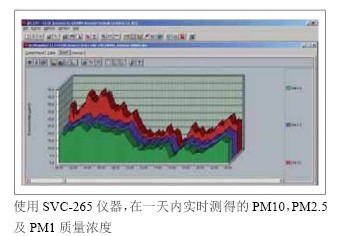
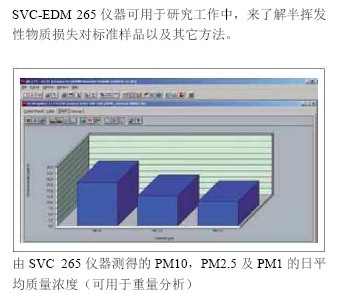
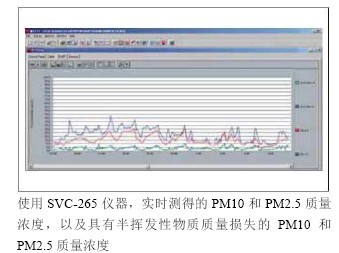
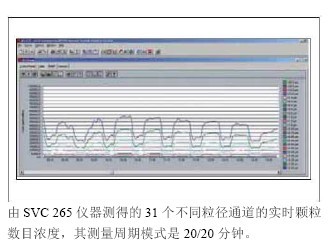
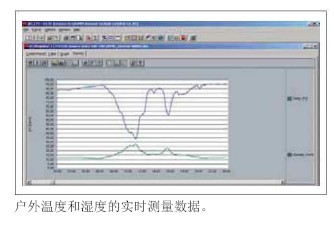
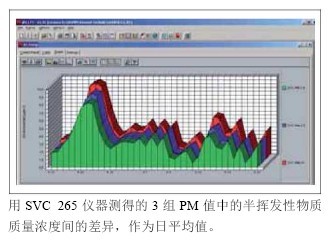
It can also display real-time maintenance data:
instrument performance
Possible alarm signals
Error message
Source analysis of particulate matter
GRIMM's environmental particle analyzer is very powerful and can provide real-time information on the source analysis of particulate matter.
Real time measurement of PM10, PM2.5, and PM1 values, combined with meteorological data, can accurately identify the source of dust particles.
Changes in aerosol particle size can be observed in the PM value, which helps us understand and determine the type of pollution source.
For example, due to emissions from local factories or nearby airports or other sources of pollution, the concentration of dust particles may increase.
This is a significant progress in atmospheric environmental monitoring.
GRIMM SVC-EDM 265 Environmental Dust Monitor
Measurement principle: 90 ° light scattering
Measurement range: 0.25 to 32 µ m with 31 different particle size channels, simultaneously measuring PM10, PM2.5, and PM1; The dust concentration ranges from 0.1 to 1500 µ g/m ³.
Temperature range: from ambient temperature to+300 ° C
Particle quantity: 1 to 2000000 particles/liter
Dust quality: 0.1 to 1500 µ g/m ³
Sampling flow rate: 1.2 liters per minute, volume flow control
Repetitive ability: 3% of a large number of processes
Instrument casing: stainless steel structure, insulated, with 3 locks, controlled by internal heating and ventilation system
Power supply: 230VAC, 50Hz/110VAC, 60Hz
Size and weight: 80 × 60 × 40cm, 27kg
Sampling tube length: 1.5 meters or 3 meters (optional)
Alternatively, the SVC-EDM 265 instrument can be switched to counting mode
SVC-ECM 265 instrument, then provides measurements within 31 different particle size channel ranges
Result:
0.25-0.28-0.3-0.35-0.4-0.5-0.58-0.65-0.7-0.8-1.3-1.6-2.0-2.5-3.5-4-5-6.5-7.5-8.5-10.25-15-17.5-20-25-30-32 µ m and above.
Similar Product Recommend