-
E-mail
19mro@19mro.com
-
Phone
13916696061
-
Address
Room 1408, Jincheng Building, No. 511 Tianmu West Road, Jing'an District, Shanghai
Product Categories
Shanghai Huifen Electronic Technology Co., Ltd

GRIMM 130 PAH detector
NegotiableUpdate on 01/21
- Model
- Nature of the Manufacturer
- Producers
- Product Category
- Place of Origin
Overview
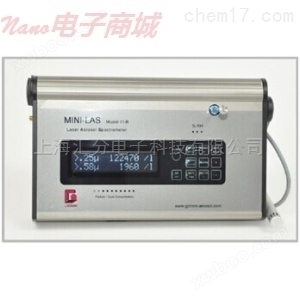
GRIMM 130 PAH detector 130 particle bound PAH detector for real-time detection of particle bound polycyclic aromatic hydrocarbons
Product Details
Basic concepts of instruments
This kind of smallPAHThe sensor can be integrated into any of our existing dust monitor housings (as shown in the figure below, #)165 FG)Alternatively, it can be used in conjunction with portable monitors to replace external filtering elements.
The air sample, air flow rate, and power supply are supplied by the dust monitor. Measurement data is accessibleRS-232Obtained through a single line interface or analog output terminal. The latter two interface methods can be used for data storage, and107Instrument data storage card and "environmental monitoring instrument software" are used for monitoring.
orRS-232The interface can provide more detailed measurement data and allow configuration and remote controlPAHSensors. In addition to meteorological sensors, this highly sensitive sensor can be integrated with our indoor air quality monitors or environmental sensorsPM10andPM2.5The monitor is used together as a particle species determination sensor.
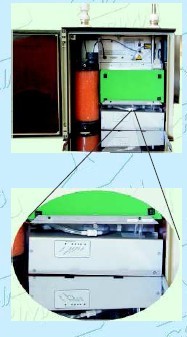
Application scenarios:
In addition to the particle size distribution of fine particles, continuous measurementsPAHData is very important information that helps determine the content of volatile compounds in the atmosphere.
Therefore, the following locations were measuredPAHConcentration can provide better information about heating and burning different fossil fuels in places such as:
* Roadside;
* Forest and industrial fires;
* Wood burning;
* Tunnels, subways, and so on
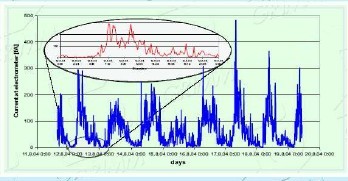
The following image shows a busy traffic intersectionPAHDaily concentration changes.
Measuring principle
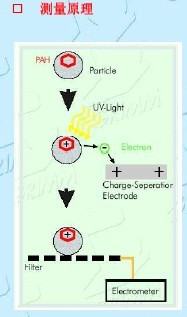
Measurement principle: Particle bindingPAHPhotoionization effect.
PAHSensors can qualitatively measure the concentration of polycyclic aromatic hydrocarbons bound to particles.PAHSensors use excimer lamps to charge particles through photoelectric action, and these particles will be collected on a filter. Use an electrostatic meter to measure charge flow. This can relatively measure the binding of particlesPAHConcentration, or through appropriate calibration, can be measured more accuratelyPAH.PAHSensors can qualitatively measure allPAHThe concentration is faster and more cost-effective than traditional measurement methods such as filtration extraction and corresponding gas chromatography-mass spectrometry analysis. However,PAHSensors cannot distinguish each individual type separatelyPAHThe concentration.
PAHTechnical Description of Sensors
Photoionization to detect particle bindingPAH
Measuring range0-5000Fa
Measurement sensitivity:~ 1ng/m³
Data transmission rate:< 6 sto2 h
Airflow rate:1.2l/min
Instrument status indication: ThroughLEDinstruction
Inlet aerosol temperature: +10 to +60 °C
Operating Temperature +5 to +50 °C
Storage temperature -20 to +50 °C
Pressure range: 1013 ±100 mbar
Relative humidity:0 - 95 % RH (No condensation)
User interface:
RS-232Full duplex, no handshake signalASCII
Analog signal output(optional):0-5V (1-4V=0-500fA or 0-5000fA) I2C: Dependent type
size(LWH):240 x 75 x 75 mm
quality1.8 kg
power supply18 VDC (rated), max.1.2 A (peak current)
Similar Product Recommend