-
E-mail
13858178172@139.com
-
Phone
13858178172
-
Address
66 Zhoushan East Road, Hangzhou City, Zhejiang Province
Product Categories
China National Building Materials Intelligent Automation Research Institute Co., Ltd
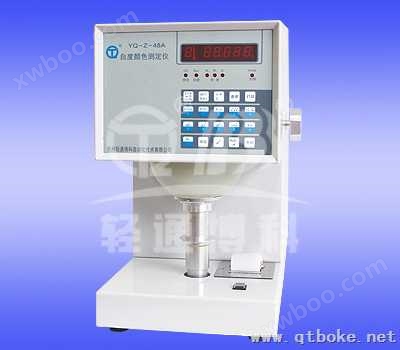
Whiteness color analyzer
NegotiableUpdate on 03/29
- Model
- Nature of the Manufacturer
- Producers
- Product Category
- Place of Origin
Overview
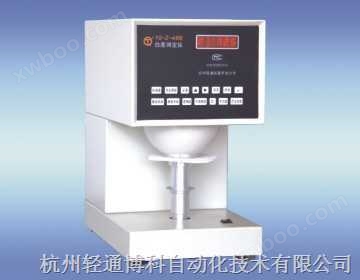
The YQ-Z-481 whiteness and color analyzer produced by Hangzhou Qingtong Boko is mainly used to measure the whiteness, yellowness, color, and color difference of objects. It is widely used in industries such as papermaking, printing, ceramics, chemical engineering, textile printing and dyeing, building materials, grain, salt production, etc.
Product Details
YQ-Z-481 Whiteness Color Tester Detailed Introduction
1、 Product Introduction
Whiteness color analyzerAlso known as: whiteness colorimeter, colorimeter, colorimeter, colorimeter, color analyzer, whiteness colorimeter, comparative colorimeter, colorimeter, color analyzer, color measuring instrument. Widely used in industries such as papermaking, printing, ceramics, chemical engineering, textile printing and dyeing, building materials, grain, salt production, etc., it is used to determine the whiteness, yellowness, color, and color difference of objects. It can also measure the opacity, transparency, light scattering coefficient, light absorption coefficient, and ink absorption value of paper. The main functions are as follows:
Measure object chromaticity, color difference, and Hunter system valuesLab;
Measuring objectsISOWhiteness (blue light whiteness)R457)AndZWhiteness(Rz)Fluorescence whitening degree of fluorescent whitening materialsF;
measurementCIEWhiteness (Ganz whiteness)W10And color deviation valueTw10);
Measure ceramic whiteness and Hunter whitenessWH;
Measure the whiteness of building materials and non-metallic mineral productsWJ;
Measure yellownessYI;
Measure transparencyTOpacityOPLight scattering index and light absorption index;
Measure the ink absorption value.
2、 Adopting standards
GB/T 3978: Standard lighting fixtures and geometric conditions;
GB/T 7973: Determination of diffuse reflectance coefficient of paper, cardboard and pulp(diffuse/Vertical method);
GB/T 7974: Determination of brightness (whiteness) of paper, cardboard, and pulp(diffuse/Vertical method);
ISO 2470: Blue diffuse reflectance factor of pulp, paper, and cardboard(ISObrightness)Measurement of;
GB/T 7975: Paper and cardboardColor measurement (diffuse reflectance method);
GB/T 3979: Measurement methods for object color;
GB/T 8940.2: Preparation of pulp brightness (whiteness) samples;
GB/T 2913: Plastic whiteness test method;
GB/T 13025.2: General test methods for salt industryDetermination of whiteness;
GB/T 5950: Measurement method for whiteness of building materials and non-metallic mineral products;
GB/T 9338: fluorescent whitening agentDetermination of relative whitenessInstrument method;
GB/T 9984: Test method for industrial sodium tripolyphosphate;
GB/T 13173: surfactantTest method for detergent;
GB/T 13835.7: Test method for whiteness of rabbit hair fiber
GB/T 4739: Method for determination of chromaticity of daily ceramic pigments
GB/T 6688: Determination of relative strength and color difference of dyesinstrumental method
GB/T 8424.1: textileColor fastness testGeneral rules for determining surface color
GB/T 8424.2: textileColor fastness testInstrument evaluation method for relative whiteness
GB/T 8424.3: textileColor fastness testColor difference calculation
GB/T 11186.1: Measurement method for coating color*Partialprinciple
GB/T 11186.2: Measurement method for coating colorPart Twocolor measurement
GB/T 11186.3: Measurement method for coating colorPart IIIColor difference calculation
GB/T 11942: Color measurement method for colored building materials
QB/T 2789: General Test Methods for CosmeticsColor tristimulus value and color difference △E*determination;
ISO 2471: Paper and cardboard opacity(Paper backing)Measurement of diffuse reflectance method;
GB/T 1543: Determination of opacity of paper and paperboard (paper backing) using diffuse reflectance method;
GB/T 10339: Determination of light scattering and absorption coefficients of paper, cardboard, and pulp;
GB/T 12911: Determination method for ink absorption of paper and cardboard;
HG/T 3862: Plastic Yellow Index Test Method;
GB 9087: Powder standard whiteboard for chromaticity and photometry measurement;
.
III Specifications and main technical parameters
1SimulationD65Light source illumination. adoptCIE1964Supplementing the chromaticity system andCIE1976(L*a*b)Color space color difference formula;
2Adoptingd/oIllumination observation geometry conditions. Diffuse sphere diameter150mm,Test hole diameter25mm,Equipped with a light absorber to eliminate the influence of mirror reflection light on the sample;
3Measurement repeatability:δ(Y10)<0.1,δ(x10They10)<0.001;
4Accuracy: △Y10<1.0;
5Sample size: Test plane ≥ ¢30mm,Thickness ≤40mm;
6Power supply:220V±10%, 50Hz;
7Working environment: Temperature10~30℃The relative humidity should not exceed 85%;
8External dimensions (length x width x height),mm:370×270×410;
9Instrument quality: approximately15kg.
4、 Product performance characteristics
The instrument adopts integrated technology of light, machine, and electricity, as well as microcomputer measurement and control technology. It has the function of statistical processing of test data, can print and output, and can measure the whiteness (brightness) and chromaticity of various objects.
1Measure the color of the object, report diffuse reflectance factors RX, RY, Rz, stimulus values X10, Y10, Z10, chromaticity coordinates X10, Y10, brightness L *, chromaticity a *, b *, chroma C * ab, hue angle h * ab, dominant wavelength λ d, excitation purity Pe, color difference Δ E * ab, brightness difference Δ L *, chroma difference Δ C * ab, color tone difference Δ H * ab, Hunter system L, a, b;
2Determine the yellowness YI;
3Measure the opacity OP;
4Measure the light scattering coefficient S;
5Measure the light absorption coefficient A;
6Measure transparency;
7Measure the ink absorption value;
8Reference samples can be physical objects or data. The instrument can store up to ten reference sample information for memory storage;
9Multiple measurements can be averaged; Digital display and printable report of measurement results;
10The instrument has a memory function. Even if the device is shut down or loses power, useful information such as memory zeroing, calibration, and measurement values of standard and reference samples will not be lost.
5、 Supporting sampling equipment
HY-1Constant pressure sampler.