-
E-mail
632697258@qq.com
-
Phone
13833997272
-
Address
No. 16, High tech Development Zone, Cangzhou City, Hebei Province
Product Categories
Hebei CCCC Railway Construction Engineering Instrument Manufacturing Co., Ltd
Parameters of concrete building materials freeze-thaw testing machine
NegotiableUpdate on 01/23
- Model
- Nature of the Manufacturer
- Producers
- Product Category
- Place of Origin
Overview
The parameters of the JCD series concrete building materials freeze-thaw testing machine are designed according to the professional standard DL/T "Test Specification for Hydraulic Concrete Sand and Gravel Aggregates" and the test conditions proposed in the standard ISO10545-12:1995. This device has the characteristics of high automation, high efficiency, and can be configured with upper computer software for remote monitoring. It can automatically complete freeze-thaw cycles according to pre-set parameters.
Product Details
1Parameters of concrete building materials freeze-thaw testing machineCharacteristics and Applications
JCD seriesParameters of concrete building materials freeze-thaw testing machineIt is designed according to the professional standard DL/T "Test Specification for Sand and Gravel Aggregates of Hydraulic Concrete" and the test conditions proposed in the standard ISO10545-12:1995. This device has the characteristics of high automation, high efficiency, and can be configured with upper computer software for remote monitoring. It can automatically complete freeze-thaw cycles according to pre-set parameters. The controller is equipped with a dot Chen LCD display, Chinese operation menu, full digital and four-way navigation keys. Before leaving the factory, different temperature curve data have been set according to the properties of various building materials. Users only need to directly select the corresponding curve when setting. At the same time, the system also has two sets of customizable parameters, which can be upgraded for other standard requirements. The inner liner is made of 304 stainless steel plate, and the refrigeration system is entirely made of imported high-quality components. Combining our company's years of experience and technology in freeze-thaw research and development, this equipment has the characteristics of low noise, low energy consumption, and stable performance.
IIworking conditions
1. The ambient temperature ranges from 5 ℃ to 35 ℃.
2. The relative humidity of the environment shall not exceed 85%.
3. There is no vibration, corrosive medium, or strong electromagnetic field interference around.
4. Place on a sturdy and flat surface.
5. The power supply is AC220V ± 5% (AC380V ± 5%) 50Hz, which is optional for users.
6. The distance between the equipment and the wall should be at least 0.5m.
III
Main technical parameters |
Main product configuration |
1. Container cavity dimensions: length 1060mm, width 620mm, height 570mm |
1. One host |
2. 40 standard red bricks or fly ash bricks, or other irregular stones and concrete that can be placed in the box, with a weight not exceeding 80KG. |
2.18B20 long pole sensor, 5 pieces |
3. Cooling rate: The temperature of the box is close to or does not exceed 20 ℃/h |
3. One serial port cable |
4. Temperature measurement accuracy: ± 0.5 ℃ (-30 ℃ -50 ℃) |
4. One set of specimen rack |
5. Equipment dimensions: length 1600mm x width 810mm x height 1300mm |
A 5.8mm organic glass panel |
6.Weight: Approximately 150Kg |
6. One manual and warranty card |
47.Power consumption:<2.5 kWh per hour |
7. Software CD |
4、 Structure
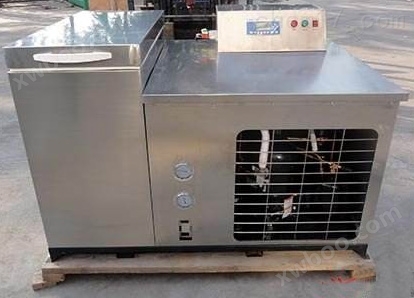
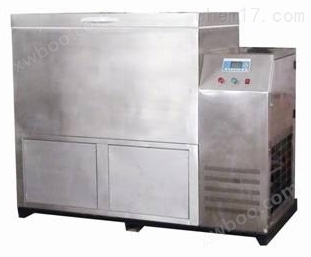
The JCD series building material multifunctional testing machine consists of six parts: control system, refrigeration system, heating system, fully automatic water injection system, specimen box, and overall box. The external structure of the device is shown in Figure 1 (the image is for reference only and the overall appearance may be changed due to technological upgrades)
5、 Working principle
The sample to be tested is placed in the sample slot, and the refrigeration system begins to cool the sample at a rate not exceeding 20 ℃/h. When the temperature drops to the set value XX, the insulation timer starts, and the temperature is controlled between the set value XX ± 3 ℃ during the insulation period. Insulate for XX minutes, start the water pump, and inject water above 7 ℃ from the water tank into the sample tank to make the sample temperature reach 5 ℃ or above. After the water pump stops and is kept warm for XX minutes, the water will automatically withdraw, and this is a cycle. After the water automatically withdraws, the refrigeration system starts up again and begins the next cycle. After XX cycles, the system stops running. The marked XX are all pre-set parameters of the system, and the operator can adjust the value of XX according to actual requirements after obtaining *.
6、 Installation and maintenance
1. After the user unpacks the box, check the installation packing list one by one.
2. Place the equipment on a sturdy and flat surface, with power supply, water supply and drainage nearby, and good ventilation to dissipate heat properly.
3. Connect the main power cord of the device to the user's power terminal (and strictly press the safety ground wire), and connect the ground wire to the metal screw of the box.
4. After the equipment is installed, adjust the level, connect the water inlet pipe to the tap water interface, and open the valve system to automatically feed water.
5. If the equipment is not used for a long time, please close the water valve and disconnect the water pipe. Open the drainage valve to drain the remaining water in the equipment. At the same time, open the test piece box door and clean it thoroughly. After the residual water evaporates, close the box door.
7、 Experimental operation sequence
1. Open the inlet valve of the water tank to ensure normal water pressure, then open the specimen box and place the specimen to be tested, and close the box door.
2. Turn on the power switch on the panel, and the microcomputer controller has been powered on. Then operate the microcomputer button to start a new test. After * times of starting, the system will self check. When the water level and refrigeration system are normal, the system will automatically start and run according to the program settings. If the water tank is short of water, it will automatically replenish water and an alarm prompt will appear.
3. After completing the set number of cycles, the system automatically enters standby mode and prompts that the test has been completed.
Similar Product Recommend