-
E-mail
zzcyyq@163.com
-
Phone
13938458005
-
Address
702, Building C, Triumphal Arch, No. 238 Tongbai South Road, Zhongyuan District, Zhengzhou City, Henan Province
Product Categories
Zhengzhou Chuangyu Technology Co., Ltd
PH meter, acidity meter
NegotiableUpdate on 03/30
- Model
- Nature of the Manufacturer
- Producers
- Product Category
- Place of Origin
Overview
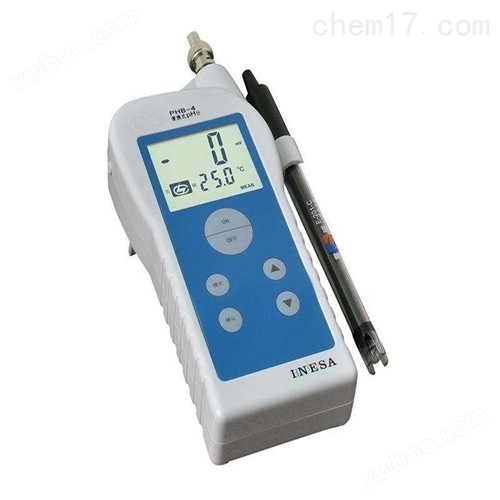
PH-4 PH meter, acidity meter $r $n with manual temperature compensation function $r $n Novel appearance, easy to carry, easy to operate $r $n Equipped with our factory's E-201-CpH composite electric
Product Details
PH-4 typePH meter, acidity meter
Main Features
3-digit backlight (optional) LCD display
Equipped with automatic calibration function
Simultaneously display pH, temperature or mV, temperature
Equipped with manual temperature compensation function
Novel appearance, easy to carry, and easy to operate
Equipped with our factory's E-201-CpH composite electrode
Main technical indicators
Instrument level: 0.1 level
1. Measurement range:
pH:(0.0~14.0)pH
mV:(0~±1400)mV
2. Resolution:
pH:0.1pH
mV:1mV
3. Basic error:
PH: ± 0.03pH ± 1 word
mV:±0.2%FS
4. Input impedance: not less than 3 × 10¹¹Ω
5. Stability: ± 0.03pH ± 1 word/3h
6. Temperature compensation range: (0-60) ℃
7. Temperature of the tested solution: (5-60) ℃
8. Power supply: Two No. 5 alkaline batteries
9. Dimensions (mm): 170 × 75 × 30
10. Weight: 0.5 kg
PH-4 typePH meter, acidity meter
Do pH measurements need to be calibrated?
There are usually two methods for pH measurement: colorimetric method (pH test paper or colorimetric dish) and electrical method. Of course, colorimetric methods do not require calibration, while electrical methods must be calibrated because electrical pH measurement is the process of comparing an unknown solution with a standard solution with a known pH value in a measuring battery. This is determined by the "operational definition" of electrical pH measurement.
There are many types of pH meters due to different electrical meter designs, and their operating steps are different. Therefore, the operation of pH meters should be strictly carried out in accordance with their instructions. Calibration is an important step in the specific operation of pH meters. The data in Table 1 are the measured values of pH meters with an accuracy of 0.01 level and qualified through metrological verification before and after calibration, indicating the importance of calibration.
Although there are many types of pH meters, their calibration methods all use the two-point calibration method, which selects two standard buffer solutions: one is pH7 standard buffer solution, and the second is pH9 standard buffer solution or pH4 standard buffer solution. Firstly, use pH7 standard buffer solution to locate the electrode, and then select the second standard buffer solution based on the acidity or alkalinity of the test solution. If the test solution is acidic, use pH4 standard buffer solution; If the test solution is alkaline, use pH 9 standard buffer solution. If the pH meter is manually adjusted, it should be operated repeatedly between two standard buffer solutions until the zero point and positioning (slope) knob no longer need to be adjusted, and the pH meter can accurately display the pH values of the two standard buffer solutions. The calibration process ends. Afterwards, the zero point and positioning knob should not be moved during the measurement process. If it is an intelligent pH meter, it does not need to be repeatedly adjusted because it has stored several standard buffer solutions with pH values for selection, and can automatically recognize and calibrate. But attention should be paid to the accuracy of the selection and preparation of standard buffer solutions. Intelligent 0.01 level pH meters generally have three to five standard buffer pH values stored, such as the KL-016 pH meter from Kelilon Corporation.
Secondly, special attention should be paid to the temperature of the test solution before calibration. In order to select the standard buffer solution correctly and adjust the temperature compensation knob on the electric meter panel to match the temperature of the test solution. The pH value of standard buffer solution varies at different temperatures.