-
E-mail
emkete@emcrafts.com.cn
- Phone
-
Address
Building 25, No. 9 Anningzhuang West Road, Haidian District, Beijing
Product Categories
- Food Quality Analyzer
- Terahertz time-domain spectrometer
- Ultra high resolution optical microscope
- Nanoindentation instrument
- electron microscope
- Electronic universal material testing machine
- atomic force microscope
- x-ray microscope
- optical microscope
- xps
- a spectrometer
- Electron microscope sample preparation equipment
- other
Platinum (Beijing) Technology Co., Ltd
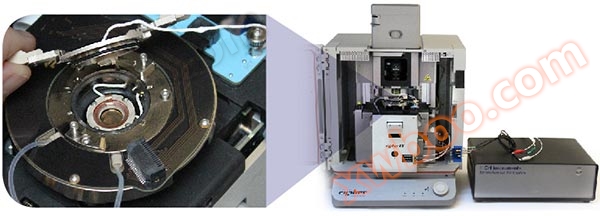
High performance electrochemical atomic force microscope (EC-AFM)
NegotiableUpdate on 01/13
- Model
- Nature of the Manufacturer
- Producers
- Product Category
- Place of Origin
Overview
High performance electrochemical atomic force microscopy (EC-AFM) 2018/09/30 Real time study of electrochemical reactions - Cypher ES atomic force microscopy now supports electrochemical functions. Oxford instrument Asylum Research Cypher ES electrochemical unit is a high-quality solution for in-situ study of electrochemical processes using atomic force microscopy. Thanks to its simple modular design, it has multifunctionality and is compatible with a wide range of material categories. What is particularly outstanding is that it is based on a Cypher ES atomic force microscope that has extremely high resolution, outstanding environmental control capabilities, ultra-high scanning speed, and easy operability on the market. Oxford Instruments Asylum Research Electrochemical Unit for Electrochemical Atomic Force Microscopy Function: The Oxford Instruments Asylum Research Fully Sealed Electrochemical Unit Kit includes independently designed probe holders, liquid cups for imaging in fluids, electrochemical sample holders, and standard electrodes. Suitable for any voltage regulator, the choice of regulator depends on the electrochemical application. Suitable for most commonly used solvents, electrolytes, and electrode materials, it is easy to clean and assemble. Even when operating with gloves, a sample stage with local heating and cooling functions can be selected to observe electrochemistry. Thermodynamics can be strictly controlled by a machine kit without reducing system performance
Product Details
Real time study of electrochemical reactions - Cypher ES atomic force microscopy now supports electrochemical functions
The Oxford Instruments Asylum Research Cypher ES electrochemical unit is a high-quality solution for in-situ study of electrochemical processes using atomic force microscopy. Thanks to its simple modular design, it has multifunctionality and is compatible with a wide range of material categories. What is particularly outstanding is that it is based on a Cypher ES atomic force microscope that has extremely high resolution, outstanding environmental control capabilities, ultra-high scanning speed, and easy operability on the market.
Oxford Instrument Asylum Research Electrochemical Unit for Electrochemical Atomic Force Microscopy Function:
The Oxford Instruments Asylum Research fully sealed electrochemical unit kit includes independently designed probe holders, liquid cups for imaging in fluids, electrochemical sample holders, and standard electrodes.
Suitable for any voltage regulator, the choice of regulator depends on the electrochemical application
Suitable for most commonly used solvents, electrolytes, and electrode materials
Easy to clean and assemble, even when operating with gloves
Optional sample stage with local heating and cooling functions to observe electrochemical thermodynamics
Optional glove box for strict environmental control without compromising system performance

Time series of AFM images showing the electrochemical stripping of copper
from a gold electrode in an acidic 0.1 M copper sulfate solution.
Imaged in tapping mode using blueDrive photothermal excitation.
Graph: Voltammogram showing reductive deposition and oxidative stripping
corresponding to the process shown in the images above.
Application of electrochemical units
Electrodeposition • Energy storage • Corrosion
Characterization of energy storage materials under bias voltage, such as battery plates, thin films, and solution electrode interfaces
Electrodeposition and dissolution of metals
Corrosion kinetics research
Monitoring the morphological changes of biocatalysts and microorganisms attached to electrodes over time, as well as other biophysical studies
Nucleation and growth of nanoparticles


