-
E-mail
6348348@163.com
-
Phone
13967891716
-
Address
No. 33 Fangcao Road, Hongtang Street, Jiangbei District, Ningbo City
Product Categories
- Insect Cage
- Constant temperature and humidity system
- Seed testing and tissue culture equipment
- Sterile homogenizer
- High throughput tissue grinder
- Energy saving drug stability test chamber
- Mask particle filtration efficiency tester
- Low concentration constant temperature and humidity weighing system
- Soil sample grinder
Ningbo Southeast Instrument Co., Ltd


Constant temperature and humidity weighing system
NegotiableUpdate on 03/12
- Model
- Nature of the Manufacturer
- Producers
- Product Category
- Place of Origin
Overview
The constant temperature and humidity weighing system is designed to meet the requirements of the new national standard HJ836-2017 "Determination of Low Concentration Weight for Fixed Pollution Sources" of the Ministry of Environmental Protection regarding the weighing conditions after sampling. The constant temperature and humidity weighing equipment solves the impact of changes in laboratory environment temperature and humidity on the weighing results of samples, improving the accuracy of weighing sample results. The constant temperature and humidity weighing equipment is also used for weighing other samples with high requirements for symmetrical weighing environments.
Product Details
Product Overview:
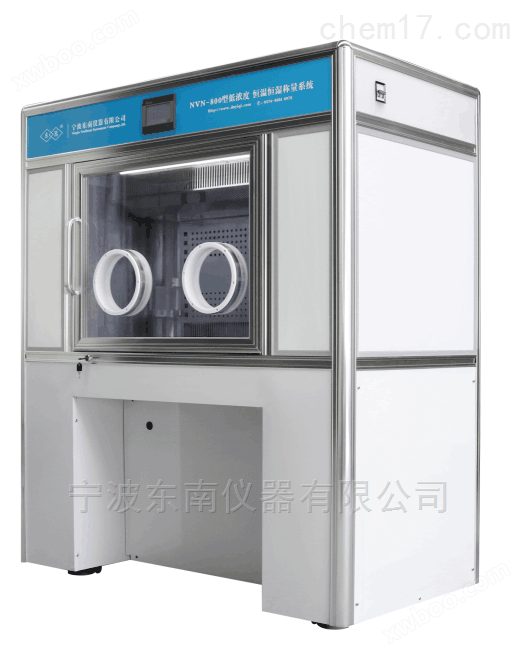
Nvn- 800 sConstant temperature and humidity weighing systemIt is to meet the new national standard HJ836-2017 of the Ministry of Environmental Protection for low concentration of fixed pollution sourcesThe requirements for weighing conditions after sampling in the "Determination of Weight Method" stipulate that a high-precision balance should be placed in a constant temperature and humidity environment. The sample to be weighed should be placed in a constant temperature and humidity chamber and equilibrated for 24 hours before weighing. The constant temperature and humidity weighing equipment solves the problem of the influence of temperature and humidity changes in the laboratory environment on the weighing results of samples, improving the accuracy of weighing sample results. The constant temperature and humidity weighing equipment is also used for weighing samples in other symmetrical environments with higher requirements.
Constant temperature and humidity weighing systemKey Features:
1.The temperature and humidity control accuracy is high, meeting the requirements of national standards HJ836-2017 and HJ656-2013. The temperature fluctuation is ± 0.2 ℃, and the humidity fluctuation is better than ± 2.0% RH. The instrument uses a Swiss Rotronic temperature and humidity transmitter, with a temperature deviation of ± 0.4 ℃ and a humidity deviation of ± 1.5% RH.
2.The system stability process is short, and the filtering process takes less than 30 minutes. After stabilization, weighing tests can be conducted at any time without waiting for the compressor to shut down like some products before weighing.
3.The human-machine interface adopts a 4-inch color touch screen, which is beautiful and durable, displaying temperature and humidity values truthfully (without fraud!), and can view temperature and humidity fluctuation curves separately through temperature and humidity curves, and view temperature and humidity historical data through table records.
4.The constant temperature and humidity box adopts a reasonable circulating air method, with soft wind and reasonable wind direction, which not only ensures uniform temperature and humidity inside the box, but also does not interfere with the weighing of the balance due to strong wind. temperature uniformity± 0.4 ℃ (i.e. 0.8 ℃), humidity uniformity ± 1.5% RH (i.e. 3.0% RH).
5.The compressor unit and casing are transported as a whole/The split operation structure not only facilitates transportation and installation, but also effectively avoids the influence of compressor vibration on the weighing balance, overcoming the problem of earthquake resistance. This instrument saves 1/3 of the floor space compared to the proportional type.
6.The compressor adopts intermittent cooling mode, which saves 85% electricity compared to continuous cooling.
7.The heating and cooling system is independent.
8.Standard purified water circulation water supply method for humidification.
9.Supply air circulation system: temperature resistant and low-noise air conditioning motor, multi blade axial flow fan.
10.There are two operation entrances on the box, which are isolated with latex gloves to avoid the influence of manual operation on constant temperature and humidity conditions.
11.Overall equipment overheating, overload, and leakage protection, compressor overpressure protection, and low voltage protection.
12.In case of sudden situations such as leakage, sound and light alarms, automatic shutdown after alarm, and other protections.
13.Different sample supports can be configured to weigh different samples.
14.Optional imported high-precision 1/100000 electronic balance, color touch screen, Chinese operating system, dual range, fully automatic calibration.
System Introduction:
At present, ordinary constant temperature and humidity equipment on the market can no longer meet the requirements of the standard. Ningbo Southeast Instrument Co., Ltd. has developed a low concentration weighing constant temperature and humidity equipment that meets the requirements of the new national standard HJ836-2017 according to the new standard requirements. Breaking the monopoly of foreign equipment in this area, making product prices more in line with market demand and easier to promote new standards.
Technical Indicators:
Main parameters |
parameter range |
Temperature range: |
15-30 ℃, temperature can be set at any point (factory setting is 20 ℃) |
Humidity range: |
40%RH~60%RH, Can be set at any point (factory set to 50% RH) |
Temperature fluctuation: |
±0.2℃ |
Temperature deviation: |
±0.4℃ |
Temperature uniformity: |
± 0.4 ℃ (i.e. 0.8 ℃) |
Humidity fluctuation: |
±2.0%RH |
Humidity deviation: |
±1.5%RH |
Humidity uniformity: |
± 1.5% RH (i.e. 3.0% RH) |
Heating and cooling rate: |
≤(0.6-1.2)℃/min |
Dimensions (length x width x height): |
1300mm×730mm×1580mm |
Power supply: |
220-240VAC 50/60HZ |
1、 Recently, the Ministry of Environmental Protection released a new standard for measuring low concentrations of fixed pollution source exhaust gas: "Determination of Low Concentration Particulate Matter in Fixed Pollution Source Exhaust Gas by Weight Method" (HJ836-2017). The new standard will be officially implemented on March 1, 2018. At the same time, the Ministry of Environmental Protection has revised the "Determination of Particulate Matter and Sampling Methods for Gaseous Pollutants in Fixed Pollution Sources" (GB/T16157-1996), which will also be implemented together with HJ836-2017. The release of this new standard is bound to touch the hearts of millions of environmental testing personnel.
IIRequirements for the detection limit of the new standard
The detection limit of HJ836-2017 "Determination of Low Concentration Particulate Matter in Exhaust Gas from Fixed Pollution Sources by Weight Method": The modified content of "Determination of Particulate Matter in Fixed Pollution Sources and Sampling Methods for Gaseous Pollutants" (GB/T16157-1996): Add "1.2 When determining the concentration of particulate matter in exhaust gas from fixed pollution sources, if the concentration is less than or equal to 20mg/m3, it is applicable to HJ836 (Determination of Low Concentration Particulate Matter in Exhaust Gas from Fixed Pollution Sources by Weight Method), and the concentration is greater than 20mg/m3 and does not exceed 5When the concentration is 0mg/m3, the measurement result is stated as'<20mg/m3 '
IIICurrent pollution source emission standards
Overview of emission standards for fixed pollution sources in China
Standard Name |
Standard Number |
Emission limit (mg/m3) |
remark |
Emission Standards for Air Pollutants from Thermal Power Plants |
GB13223-2011 |
5-30 |
|
Emission Standards for Air Pollutants from Boilers |
GB13271-2014 |
20 |
|
Emission Standards for Pollutants in Coking Chemical Industry |
GB16171-2012 |
15-50 |
|
Emission Standards for Air Pollutants from Cement Plants |
GB4915-2013 |
10-30 |
Different production processes and equipment require different requirements |
Atmospheric Emission Standards for Crematorium |
GB13801-2015 |
80 |
|
Emission Standards for Pollutants from Petroleum Refining Industry |
GB31570-2015 |
20-50 |
Process heating furnace 20mg/m3, catalytic cracking catalyst regeneration flue gas 50mg/m3. |
Emission Standards for Pollutants in Petrochemical Industry |
GB31571-2015 |
20 |
Process heating furnace |
Pollutant Emission Standards for Synthetic Resin Industry |
GB31572-2015 |
30 |
|
Emission Standards for Pollutants from Inorganic Chemical Industry |
GB31573-2015 |
30 |
|
Emission Standards for Industrial Pollutants from Recycled Copper, Aluminum, Lead, and Zinc |
GB31574-2015 |
30 |
|
Emission Standards for Industrial Pollutants of Tin, Antimony, and Mercury |
GB30770-2014 |
50-80 |
The emission limit for particulate matter in the smelting process is 80mg/m3, and the emission limit for particulate matter in the acid production process from flue gas is 50mg/m3. |
Therefore, only by obtaining both HJ836-2017 and GB/T16157-1996 testing qualifications can relevant testing institutions meet the monitoring requirements for industrial particulate matter emissions and environmental management needs, as well as the monitoring requirements for ultra-low emission environmental protection renovation of coal-fired power plants.