-
E-mail
info@cell-regen.com
-
Phone
18513354055
-
Address
2nd Floor, Building 4, No. 11 Chaoqian Road, Changping Park, Zhongguancun Science and Technology Park, Changping District, Beijing
Product Categories
Serruicheng (Beijing) Life Science Technology Co., Ltd
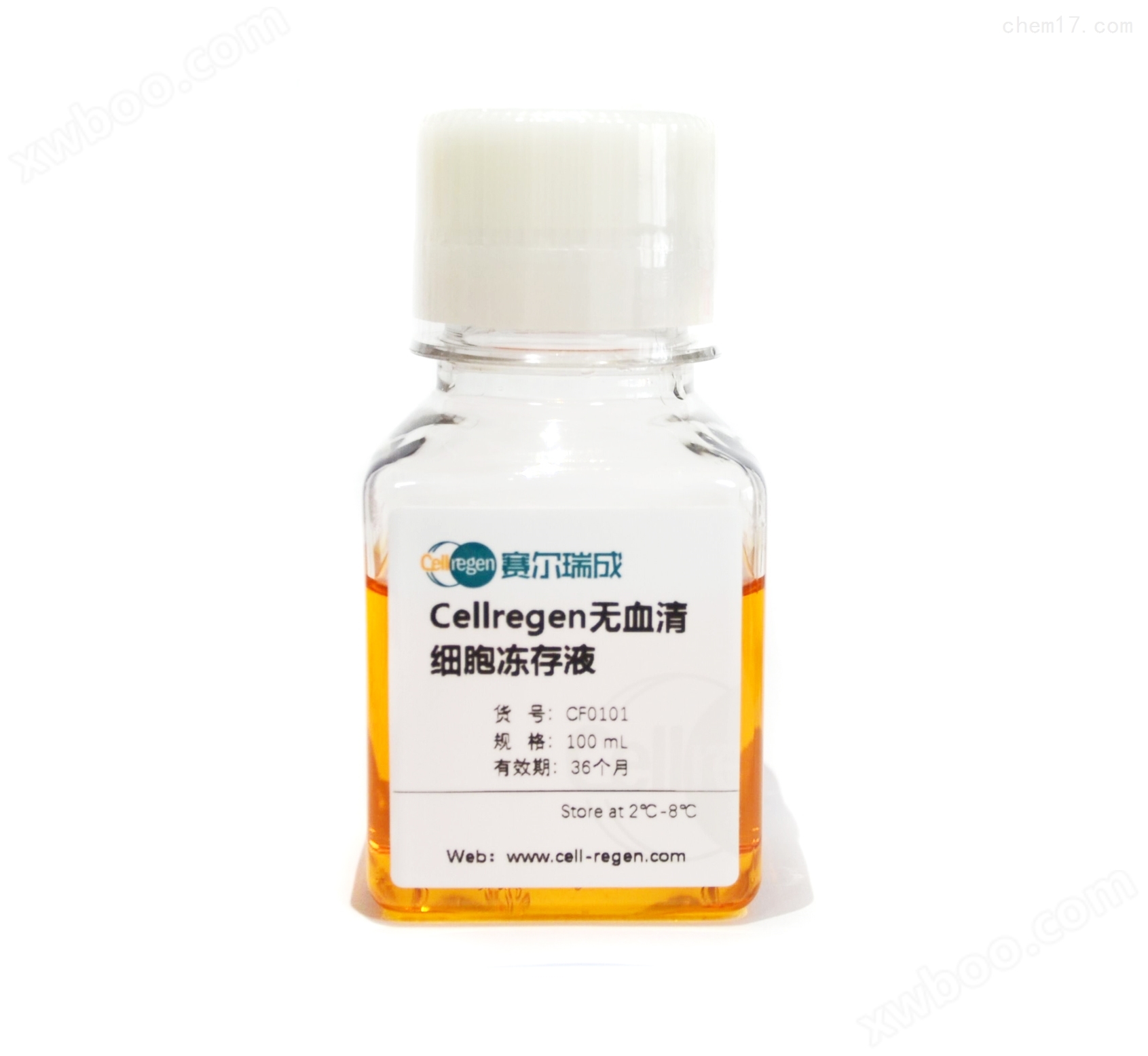

Cellregen serum-free cell cryopreservation solution
NegotiableUpdate on 01/21
- Model
- Nature of the Manufacturer
- Producers
- Product Category
- Place of Origin
Overview
Cellregen serum-free cell cryopreservation solution is commonly used for human and various animal cell lines; $r $n Non programmed cooling; $r $n-80 ℃ freezer can be stored for up to 5 years.
Product Details
Cellregen serum-free cell cryopreservation solution

Cellregen serum-free cell cryopreservation solutionIt is a universal cell cryopreservation solution that can be used for cryopreservation of human and various animal cell lines;
Non programmed cooling, stored in a -80 ℃ freezer for up to 5 years;
The special formula (mainly composed of DMSO and amino acids) effectively improves cell freezing survival rate and recovery vitality;
Free from animal derived proteins, it can reduce contamination from various viruses, molds, and mycoplasma, ensuring the safety of frozen cells;
It is suitable for cryopreservation of both general cultured cells and serum-free cultured cells and protein expressing cells.
Product Catalog
Item Number |
Product Name |
Specifications |
Catalog price |
CF0101 |
Cellregen serum-free cell cryopreservation solution |
100 mL |
690 |
CF0102 |
Cellregen serum-free cell cryopreservation solution |
200 mL |
1290 |
CF0103 |
Cellregen serum-free cell cryopreservation solution |
500 mL |
2890 |
For a more favorable price, please contact the customer service of Cellregen to apply for a 2ml trial set of Cellregen serum-free cell cryopreservation solution
Cell cryopreservation (cryopreservation), please select Cellregen serum-free cell cryopreservation solution
Cell cryopreservation is a commonly used method in cell culture technology for seed preservation and preservation of cells. Cell cryopreservation solution, as a necessary solution for cell cryopreservation, is not only used for cell preservation, but also plays a key role in the purchase, gifting, exchange, and transportation of cellsTherefore, choosing a good cell cryopreservation solution is particularly important.
Traditional cell cryopreservation solution involves adding a protective agent to the culture medium, typically 10% dimethyl sulfoxide (DMSO) and 10% -90% bovine serum. These substances can lower the freezing point of the solution, increase the permeability of the cell membrane to water, and under slow freezing conditions, allow water to seep out of the cell, reducing ice crystal formation and avoiding cell damage.Serum,Purified albuminDue to its animal derived nature, there is an increased risk of viral contamination, and issues such as limited serum sources, high prices, and differences in quality can also lead to instability and high costs in traditional cell cryopreservation.Meanwhile,Traditional cell cryopreservation requires placement in liquid nitrogen at -196 ℃, which is a cumbersome process that requires programmed coolingIf the freezing tube is first placed in a 4 ℃ freezer for 10 minutes, then moved to a -20 ℃ freezer for 30 minutes, and then moved to a -80 ℃ freezer for 16-18 hours (or overnight), before being transferred to a liquid nitrogen tank for storage. (It should be noted that under -20 ℃ conditions, it should not exceed 1 hour to prevent excessive ice crystal growth, which may cause a large number of cell deaths.)
It can be seen that the problems encountered when traditional cell cryopreservation solutions are summarized as follows:
☆ Program cooling is required (4 ℃ → -20 ℃ → -80 ℃ → liquid nitrogen), which is cumbersome, time-consuming, and labor-intensive;
☆ Contains serum, with a higher risk of cell contamination (viruses, molds, mycoplasma, etc.);
Differences in serum batches and quality lead to batch differences in the frozen solution;
High freezing requirements, liquid nitrogen freezing is required, and in-situ freezing (such as orifice plates) is not possible
The Serrui Cheng technology team has conducted extensive research in the field of cell cryopreservationIndependently developed 'Cellregen serum-free cell cryopreservation solution', is a universal cell cryopreservation solution that does not contain serum or animal derived componentsCompared to traditional cell cryopreservation solutions, there are advantages:
☆ Does not contain serum or animal derived proteins, reducing contamination from viruses, fungi, and mycoplasma;
☆ Special formula, effectively improving cell cryopreservation survival rate and recovery rate;
☆ Ready to use type, no need for on-site configuration, ready to use immediately;
☆ Universal type, suitable for cryopreservation of various animal and human cell lines and primary cells;
The ingredients are clear and there are no differences between batches;
☆ No need for program cooling, can be directly stored at -80 ℃ for easy operation;
☆ No need for liquid nitrogen, can be stably frozen in a -80 ℃ freezer for up to 5 years;
☆ Can be cryopreserved in small amounts and in situ, such as the cryopreservation of hybridoma cells, which is time-saving and efficient
Example of product freezing effect

Currently validated cell types for cryopreservation:
Human T lymphocytes, human B lymphocytes, human NK cells, human mesenchymal stem cells, human fibroblasts, human umbilical vein endothelial cells (HUVEC), human renal epithelial cell line (293T), human primary immature DC cells (imDC), human breast cancer (MCF-7/MDA MB-231), GFP labeling human breast cancer, human non-small cell lung cancer (A549), human skin keratinocytes (HACAT), human pancreatic cancer (Capan-1/PANC-1/AsPC-1), human colon cancer (HT-29), human prostate cancer (PC 3), human liver cancer (HepG2), human cervical cancer (Hela), human chronic myelogenous leukemia cells (K562), mouse myeloma cells (Sp2/0), Chinese hamster ovary cells (CHO), mouse primary spermatogonial stem cells, mouse hemangioendothelioma cells (EOMA), mouse pancreatic cancer (PAN02), mouse breast cancer (4T1) Mouse lung cancer (LLC), mouse embryonic fibroblast (MEF), rat bone marrow endothelial progenitor cells, mouse brain microvascular endothelial cells (bEnd 3), mouse melanoma (B16), knockout of TSC2-B16, knockout of insulin receptor-PANO2, knockout of insulin receptor-Capan-1, knockout of VEGFR-HUVEC, knockout of EGFR-231, knockout of estrogen receptor MCF7
Since its launch, the product has gained the love of a large number of scientific researchers. Summary of user units:
Peking University School of Medicine, Beijing Friendship Hospital, Xuanwu Hospital, Beijing Hospital, Tsinghua University, Chinese Academy of Sciences, Shandong University, Sun Yat sen University, Shanghai Jiao Tong University, China Institute of Medical Biotechnology, Shanghai Tenth People's Hospital, Shanghai Academy of Sciences, Xi'an Jiaotong University, Chongqing Third Medical University, Fujian Normal University, Wuhan University, Qinghai University, Southwest Medical University .....
Attached Comparison Table
|
Traditional cell cryopreservation solution |
Cell Rain Serum-free cell cryopreservation solution |
Main ingredients |
Containing serum, containing DMSO 10% |
Does not contain serum, contains DMSO 10% |
cytotoxicity |
tall |
tall |
safety |
low The risk of contamination from animal derived viruses, molds, and mycoplasma is relatively high |
tall There is no risk of contamination from animal derived viruses, molds, and mycoplasma |
Types of frozen cells |
Suitable for serum containing cell cryopreservation |
Universal Suitable for various types of cell cryopreservation |
Cell growth status in serum-free culture |
Easy to change, easy to return from suspended state to attached state |
Maintain suspended culture state |
Batch differences |
Large batch differences |
No batch differences |
Operation Method |
The steps are cumbersome Program cooling and freezing are required |
Simple and quick One step cryopreservation -80 ℃ refrigerator |
Save device |
High requirements (liquid nitrogen) |
Low requirements( -80℃ Refrigerator) |
Micro freezing storage |
Cells are prone to death and have a low survival rate |
High cell survival rate |
In situ cryopreservation |
infeasible |
Feasible, convenient and fast as : Cryopreservation of hybridoma cell well plates
|