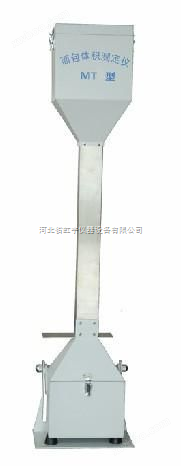
【 Premium * 】 Bread Volume Measuring Instrument
【 Premium * 】 Bread Volume Measuring Instrument
Calculation formula for bread volume measuring instrument:
N ×V N ×V × 1000 ……(2)
T= × 100 = W × 25 / 250 W
In the formula: T - acidity, ° T;
N - Equivalent concentration of 0.1mol/L sodium hydroxide standard solution;
V - volume of 0.1mol/L sodium hydroxide solution consumed, ml;
W - Sample quality, g。
Bread volume measuring instrument Allowable difference:
The difference between the two analysis results should be less than 0.1 °. The determination of yeast fermentation power is shown in Appendix A. The hygiene inspection shall be carried out according to the method specified in GB 5009.56
Bread volume measuring instrument Calculation method:
P=V/W…………(1)
式中: P—— 面包比容, ml/g;
V - bread volume, ml;
W - Weight of bread, g. Allowable difference: The difference between two measured values should be 0.1ml/g. Moisture content: determined by the * method in GB 5009.3. Sampling is based on the center of the bread.
Bread volume measuring instrument Acidity test:
1 Reagent and Instrument Sodium Hydroxide (GB 629 analytical grade): 0.1N solution, prepared and calibrated according to GB 601; *Indicator solution: 1% ethanol solution; Alkaline burette.
Bread volume measuring instrumentMeasurement steps
a. Weigh the bread to be tested (accurate to 0.1g);
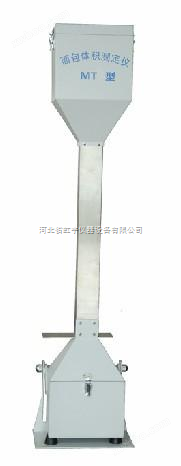
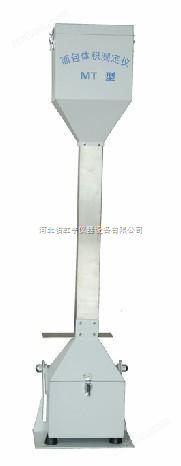
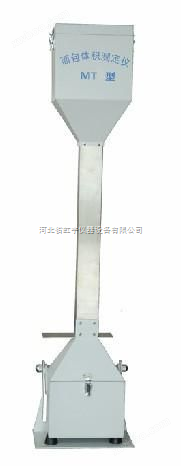
b. Select a bread module with an appropriate volume (similar to the volume of the bread to be tested), place it in the bottom box of the volumetric instrument, cover it, and place the filling material from the top of the volumetric instrument to the zero line of the ruler. After covering the top cover, invert it several times to eliminate dead corners and gaps, and adjust the amount of filler added to the zero line of the ruler;
c. Take out the bread module and put in the bread to be tested. Pull open the plug to allow the filling material to fall naturally. Read the scale of the filling material on the ruler, and the R&D unit Hebei Hongyu Instrument Equipment Co., Ltd. takes it as the measured volume of bread. typeBread volume measuring instrumentschematic diagram
Bread volume measuring instrument Precautions
1. It should be placed in a dry and clean place to keep the inside of the box clean and hygienic.
2. Before each experiment, check the zero point, and after the experiment, clean up the debris of the tested food.
3. During use, the insertion and extraction of the plug-in board should be done with appropriate force to allow the filling material to fall naturally without colliding with the instrument, so as not to affect the measurement results.
4. Preparation of filling material (rapeseed) before use: Remove impurities and wash away dust from about 2kg of rapeseed, air dry it, and place it in an oven below 105 degrees Celsius for 30 minutes. After cooling, put it in a plastic bag for later use.Hebei Hongyu Instrument Equipment Co., Ltd. insists on“Quality *, user *, reputation based”Our mission is to wholeheartedly provide pre-sales and after-sales service for our customers. The products sold come with a one-year free warranty and lifetime maintenance, earning the trust of both new and old customers with high-quality products and a good reputation Integrity management, equipment *, superior quality, affordable prices, professional manufacturing and sales Bread volume measuring instrument
Other flagship products of the company:
Hebei Hongyu Instrument Equipment Co., Ltd. is a comprehensive company that integrates scientific research, production, sales, and maintenance services nationwide. We are a professional instrument agent and buyout merchant. It is a designated production unit approved by the Building Materials Bureau and the Building Materials Brick and Tile Testing Center for 'brick and tile instruments, cement material testing instruments'. The product is supervised and tested by the Cement and New Materials Institute of the Building Materials Research Institute before leaving the factory. The company is currently operating ISO9002 quality system certification. We have achieved standardized management, organized work, specialized production, skilled job positions, and specialized personnel, laying a solid foundation for the development of the enterprise.
The company has a research and development department, which is engaged in the development and production of product testing equipment based on new standards. The technical department provides a series of services to users, including consulting services, equipment installation, debugging and maintenance, training, etc. Business Department, Marketing 'Brick and Tile Testing Instrument Series, Cement Testing Instrument Series, Mechanical Testing Equipment Series, Concrete Testing Instrument Series, Civil Engineering Testing Instrument Series, Asphalt Testing Instrument Series, Road Surface Testing Instrument Series, Highway and Railway Instrument Series, Optical Surveying Instrument Series, Construction Engineering, Non destructive Testing Instrument Series, Food Microbial Testing Instrument Series, Food Quality Testing Instrument Series, Grain and Oil Food Analysis Instrument Series, Experimental and Testing Instrument Series, Physical Inspection, Chemical Analysis Instrument Series, Waterproof Membrane Testing Instrument Series, Teaching and Research Instrument Series, Chemical Reagent, Glassware Series, Standard Substance, Standard Sample Series'.
Address: No. 198, Yunxi Development Zone, Cangzhou City, Hebei Province
:0317-463327 4406818 4406928
4406818
: (24/7 consultation service)
:www.hongyuyiqi.net
 |
| NJ-160A cement slurry mixer |
Mix cement and water according to the standard specifications to form a uniform test slurry, which is used to determine the standard consistency and setting time of cement and to make qualitative test blocks
Main technical parameters:
Slow revolution speed of stirring blade: 62 ± 5r/min
Rapid revolution of stirring blade: 125 ± 10r/min
Slow rotation speed of stirring blade: 140 ± 5r/min
Rapid rotation of stirring blades: 285 ± 10r/min
Mixing blade width: 111mm
Mixing pot size: (inner diameter x maximum depth)
Φ160mm×139mm |
|
 |
| JJ-5 typeCement sand mixer |
Designed by China National Building Materials * Cement Institute, it is a unified equipment specified in the standard "ISO method for testing the strength of cement mortar (GB/T17671-1999)", suitable for mixing during the preparation of cement mortar specimens, and can be used for cement testing and mixing of cement paste and mortar according to American and Japanese standards.
Main technical parameters:
1. Mixing blade width 135mm
2. Mixing pot capacity 5L
3. Mixing blade speed r/min (table omitted)
4. Net weight ≈ 70kg |
|
| |
|
 |
| ZT96 type adhesive sand specimen forming vibration compaction table |
This compaction table is an equipment used to determine the strength of cement mortar according to the ISO679:1989 cement strength test method, and its structure and performance meet the requirements of JC/T682-1997.
Main technical parameters:
Amplitude: 15mm ± 3mm
Vibration frequency: 60 times/S ± 1S
Total weight of the table (including arm): 13.7Kg ± 0.25Kg
Volume: 104 × 300 × 460mm
Power supply: 220V |
|
 |
| DKZ-5000 electric flexural testing machine |
Determination of flexural strength of test blocks used for cement or other non-metallic brittle materials
Main technical parameters:
Maximum test force: 1000N when using a horizontal bar
When using parallel bars: 5000N
Indication accuracy: ± 1%
Horizontal bar output ratio: 10:1
Parallel bar output ratio: 50:1
Loading rate (dual lever): 50N/S |
|
| |
|
 |
| TS45 Cement Mortar Flow Tester |
| Determine the water consumption for the standard consistency of cement mortar by measuring its flowability value. |
|
 |
| FZ-31A type all stainless steel boiling box |
| Two methods were used to determine the stability of cement: the Rayleigh method and the test cake method. The instrument can automatically control the temperature and insulation, and can also be manually controlled. (All stainless steel) Main technical parameters:
1. Effective volume: approximately 31 liters
2. Heating and boiling time: 3 hours
3. Heating power: 2 groups totaling 4KW
4. Net weight: ≈ 20kg
|
|
| |
|
 |
| FYS-150B Negative Pressure Sieve Analyzer |
This instrument is tested according to the standard T0502-2005 (cement fineness test method 80um sieve analysis method) and is an instrument used in laboratories and cement research institutions.
Main technical parameters:
(1) Sieve analysis test fineness: 80um
(2) Screen analysis self-control time: 2 minutes (adjustable)
(3) Adjustable working negative pressure: 4000-6000Pa
(4) Working voltage: 220V~750W |
|
 |
| SBY-40A cement standard curing box |
This instrument is designed and manufactured according to the standard maintenance requirements of the cement institute and * for the new standard test blocks of cement. It is made of imported impermeable steel plates. The spray device uses ultrasonic humidification, refrigeration uses high-power compressor, temperature and humidity (digital display), and can be equipped with a micro printer (printing time can be set arbitrarily).
Main technical parameters:
Temperature controller accuracy: ± 1 ℃
Temperature difference inside the box: ≤ 1 ℃
Working voltage: 220V ± 10%
Heating power: 600W
Compressor power: 180W
Internal dimensions: 530 × 550 × 1190mm |
|
| |
|
 |
| DKZ-5000/6000 electric flexural testing machine |
Used for predicting the flexural strength of cement and other non-metallic brittle material test blocks.
The product complies with the requirements of GB/T17671, GB3350, BS4550, and ISO679 standards.
The maximum test force is 1000N when using a single lever
When using parallel bars, 5000N/6000N
Indication accuracy ± 1%
Horizontal bar output ratio 10:1
Dual bar output ratio 50:1
Loading rate (dual lever) 50N/s
Anti bending fixture
The diameter of the loading roller and support roller is 10mm
Support roller distance 100 ± 0.1mm
Partition spacing 46mm
Net weight ≈ 85kg |
|
 |
| TYE-6 cement mortar flexural testing machine |
Used for the determination of flexural strength of cement or other non-metallic brittle material test blocks.
The product complies with the requirements of GB/T17671, GB3350, BS4550, and ISO679 standards.
Power supply AC220V/50Hz (± 10%)
The maximum test force is 6000N
Loading speed 50N/s ± 5N/s
Indication accuracy ± 1%
Printer size 57mm × 103mm
Working environment temperature: 0-40 ℃
Relative humidity<80%
Dimensions 500mm × 365mm × 690mm |
|
| |
|
 |
| LD-50 type Rayleigh clamp tester |
It is mainly used to test whether the quality of the clamp meets the requirements, and also to measure the increase in the distance between the two pointers of the clamp before and after boiling to determine the stability of the cement. The product meets the requirements of GB/T1346 and ISO9597 standards.
Weight of weight 300g
Zui value scale board Zui small engraving distance 0.5mm
Net weight ≈ 1.65kg |
|
 |
| Standard viscosity and setting time tester for clean slurry |
Mainly used to determine the standard consistency, water consumption, and setting time of cement paste. The product meets the requirements of GB/T1346, ASTMC187, and ISO9597 standards.
The total weight of the sliding part is 300g
The maximum stroke of the sliding part is 70mm
Net weight ≈ |
|