-
E-mail
beckman-lq@ins-interactive.cn
- Phone
-
Address
5th Floor, Building 2, No. 518 Fuquan North Road, Changning District, Shanghai
Beckman Coulter Trading (China) Co., Ltd
Rotation Efficiency K Factor and Centrifugal Time
Date: 2022-06-02Read: 0
The value of k for turning the head
The k value of the rotor (also known as the k factor or k coefficient) is used to measure the precipitation efficiency of the rotor. All centrifuge manufacturers calculate the k value of the prepared rotor when it leaves the factory. The k value of the rotor is calculated by running it until|HighThe calculation formula for the rotational speed and centrifuge tube filled with the sample is as follows:
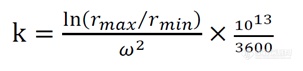 (1)
(1)
K - the value of k for turning the head
rmax- Large radius refers to the vertical distance from the rotation axis to the bottom of the centrifuge tube
rmin- Small radius refers to the vertical distance from the rotation axis to the top of the centrifuge tube
ω - angular velocity
Due to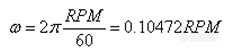 (2)
(2)
Substituting formula (2) into formula (1) yields the following formula for calculating the value of rotor k:
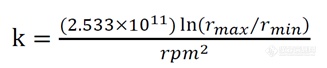 (3)
(3)
From the above, it can be concluded that the k value of the rotor is related to the rotor|HighThe speed and shape are related.
|HighThe smaller the angle between the centrifuge tube and the shaft, that is, the smaller the rmax/rmin, the smaller the k value for a rotor with the same rotational speed. So the k values of the four types of rotors in the preparation type ultracentrifuge are as follows: horizontal rotor k value>fixed angle rotor k value>near vertical rotor k value>vertical rotor k value.
If the rotor does not run during centrifugation|HighSpeed, then rpm cannot be used|HighThe k value of the rotational speed must be calculated by substituting the actual operating speed of the rotor into formula (3).
 (4)
(4)
Centrifugation time
Given the k value of a certain rotor and the settling coefficient of particles, the time required to separate particles using that rotor can be calculated. The formula is as follows:
 (5)
(5)
T - sedimentation time (unit: hour)
K - Refers to the value of k in the actual operating state of the rotor
S - sedimentation coefficient of particles
From formula (5), it can be seen that the k value of the rotary head is an indicator for evaluating the centrifugal efficiency of the rotary head. For the precipitation of the same particle, the smaller the k value of the rotary head, the shorter the time required for particle precipitation, that is, the higher the centrifugal efficiency; On the contrary, the larger the k value of the rotor, the longer the time required for particle precipitation, and the lower the centrifugal efficiency of the rotor.
For example, if a protein with a separation sedimentation coefficient of 15 S is separated and a rotor k value of 15 is used, the time required to settle the protein particles is:
T=k/s=15/15=1 hour
If the k value of the rotor used is 18, then the time required for settlement is:
T=k/s=18/15=1.2 hours
Given the k value of a rotating head and the time required for precipitation, if another rotating head is used to precipitate the same particles, the following formula can be used to calculate the time required for precipitation:
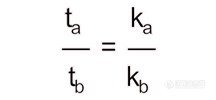 (6)
(6)
K value of ka - a rotation head
The k value of kb-b rotation head
Time required for ta-a to rotate and settle the sample
Time required for tb - b rotary head settling sample
If the turn is not in|HighRunning at the rotational speed, or if the sample is not filled, or if other smaller centrifuge tubes (such as g-MAX tubes) are used, the corresponding k value will change, and the time required for centrifugation will also need to be recalculated.
In summary, the k-factor has comprehensively considered the centrifugal speed, relative centrifugal force, and changes in the force on the sample at small and large radii, as well as factors such as the settling stroke of particles. It is an accurate and important indicator for calculating centrifugation time and evaluating the efficiency of rotor centrifugation.
Follow Xiaobei Centrifugal Classroom to learn more about centrifugal information!
Last Article: How to cultivate a flow master - sample preparation Research Chapter
Next Article: Differential Centrifugal Method